


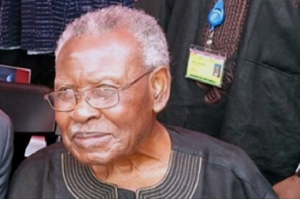
 Joseph Henry Mensah
From Finance Minister under K A Busia to Senior Minister under J A Kufuor, Joseph Henry Mensah's career spanned some of the most defining periods in Ghana's political history.
Some political figures are remembered for the offices they occupied; others leave a mark through the ideas they championed, the institutions they helped shape and the political battles they fought. Joseph Henry Mensah, popularly known as J H Mensah, belonged to the latter category.
An economist, politician and one of the influential figures in Ghana's political history, Mensah was born on 30th October 1928 in Sekondi, then part of the Gold Coast. His life and career stretched across different political eras, from the early years of post-independence Ghana to the Fourth Republic, where he remained a significant voice in national governance.
His journey was marked by academic excellence, public service, political adversity and an enduring commitment to economic development.
A career built on economic planning and public service
Mensah's contribution to Ghana's development began long before he entered active partisan politics. After studying economics at the University of the Gold Coast, now the University of Ghana, he furthered his education at the University of London and Stanford University in the United States, specialising in economic theory and development.
His professional journey began in 1953 when he was appointed an Assistant Inspector of Taxes under the colonial administration. He later worked as a Research Fellow in Economics at the University of Ghana before joining the United Nations Secretariat in New York in 1958 as an Economic Affairs Officer.
In 1961, he returned to Ghana and took up a position at the National Planning Commission under the government of Ghana's first President, Dr Kwame Nkrumah.
It was a significant period in his career. The commission was responsible for developing and implementing Ghana's Seven-Year Development Plan, covering 1962 to 1969, an ambitious national blueprint intended to guide the country's economic transformation.
Mensah's involvement in the planning process established his reputation as an economist with a strong interest in industrialisation, agricultural modernisation and the effective use of state resources.
An obituary published by Africa Confidential in 2018 described him as a man whose formidable intellect and independent spirit shaped his contribution to public service over six decades.
The publication also recalled his belief that Ghana needed a development strategy that combined industrial expansion with agricultural growth, rather than relying exclusively on either state intervention or market forces.
From economic planner to Finance Minister
Mensah's transition from economic planning to frontline politics came in 1969 when he contested and won a parliamentary seat on the ticket of the Progress Party (PP), led by Dr Kofi Abrefa Busia.
He was subsequently appointed Minister of Finance and Economic Planning, placing him at the centre of the government's efforts to manage Ghana's economy during the Second Republic.
His tenure came at a challenging time for the country. The Busia administration faced mounting economic difficulties, including pressure on foreign exchange reserves, inflation and declining cocoa prices.
In December 1971, the government introduced a major currency devaluation of approximately 44 per cent as part of its response to the economic difficulties.
However, the administration's attempts to address the economic crisis were short-lived. On January 13, 1972, the military, led by Colonel Ignatius Kutu Acheampong, overthrew the Busia government, bringing Mensah's ministerial tenure to an abrupt end.
The coup also marked the beginning of one of the most difficult chapters of his life.
Prison, exile and an unexpected political return
The overthrow of the Busia government did not end Mensah's involvement in national affairs. Instead, it ushered in years of political persecution, detention and exile.
He was repeatedly arrested following the 1972 coup and spent periods in detention, including imprisonment under the National Redemption Council between 1975 and 1978.
Despite these experiences, he remained involved in public life. He later ventured into farming, established Banka Farms and served as Chairman of the Sunyani District Council.
His political difficulties continued following the return of military rule under the Provisional National Defence Council (PNDC). In 1982, he went into exile in England, where he became involved in efforts opposing the PNDC administration.
He eventually returned to Ghana in 1995, ending a prolonged period away from the country.
His return marked the beginning of another important chapter in his political journey.
A founding NPP figure and parliamentary heavyweight
Mensah became one of the founding figures of the New Patriotic Party (NPP), which emerged from the political tradition associated with the Progress Party.
In the 1996 general elections, he contested the Sunyani East parliamentary seat on the NPP ticket and won, returning to Parliament after more than two decades away from the legislature.
He retained the seat in the 2000 elections and represented the constituency until January 2009.
His experience and political stature quickly made him an influential figure in the Fourth Republic. Between 1997 and 2001, he served as Minority Leader, leading the NPP's parliamentary group while the party was in opposition under the National Democratic Congress (NDC) government.
Following the NPP's victory in the 2000 elections, Mensah moved into government and served as Minister and Leader of Government Business under President John Agyekum Kufuor.
He subsequently served as Minister responsible for Public Sector Reform and later as Senior Minister, becoming one of the most prominent figures in the Kufuor administration.
His influence extended beyond party politics. He was also involved in continental development affairs, serving on the African Development Bank's African Advisory Council between 1993 and 1997.
More than a politician: A voice on democracy and development
Beyond the ministerial positions and parliamentary leadership, Mensah's legacy was closely associated with his views on economic development, democratic accountability and the responsibilities of public office.
He believed that economic transformation required deliberate planning, productive investment and a strong agricultural foundation.
His political journey also placed him in an unusual position: he had worked under Nkrumah's administration, served as a minister under Busia and later became a leading figure in the NPP.
That journey reflected an ability to contribute to national development across different political administrations, even though his later political identity became firmly associated with the Danquah-Dombo-Busia tradition.
He was also involved in efforts to advance the case for reparations for the transatlantic slave trade, working with Nigerian businessman and politician Moshood Abiola to push the issue onto the international agenda.
His views on democracy were equally notable. In one account published by Africa Confidential, Mensah was recalled as arguing that accountability was not exclusively a Western concept, drawing comparisons with traditional Ghanaian institutions that allowed public criticism of authority.
It was this combination of economic expertise, political conviction and intellectual independence that made him a distinctive figure in Ghanaian public life.
The final chapter of an eventful life
After decades in public service, Mensah's political career gradually came to a close. He left Parliament in January 2009 after representing Sunyani East for 12 years.
He died on July 12, 2018, at the 37 Military Hospital in Accra, aged 89, following a period of illness.
His death attracted tributes from across the political divide, with the NPP describing him as a founding father, mentor and colossus whose contributions to the party and Ghana's development could not be overlooked.
In recognition of his service to the country, he was accorded a state funeral on August 17, 2018, at the Accra International Conference Centre before being laid to rest at the Military Cemetery at Burma Camp.
Eight years after his death, J.H. Mensah remains an important figure in the story of Ghana's economic planning and parliamentary democracy.
His life offers a glimpse into the country's political evolution, from the Nkrumah era and the Second Republic to the Fourth Republic.
More importantly, it tells the story of a man whose journey through government, political opposition, imprisonment and exile never entirely separated him from the national conversation about Ghana's development.
EA

Copyright © 1994 - 2026 GhanaWeb. All rights reserved.










