


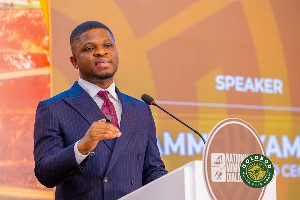
 Sammy Gyamfi is the CEO of Ghana Gold Board (GoldBod)
Ghana Gold Board (GoldBod) Chief Executive Officer, Sammy Gyamfi, has identified Colombia, Mongolia, Peru and Tanzania as four countries whose artisanal and small-scale mining (ASM) formalisation programmes offer valuable lessons for Ghana.
According to him, the experiences of these countries demonstrate how informal miners can be organised into legally recognised groups and supported to undertake responsible mining.
In a Facebook post on Saturday, October 31, 2026, Gyamfi outlined the approaches adopted by the four countries and explained how Ghana intends to draw lessons from their experiences through the Responsible Cooperative Mining and Skills Development Programme (rCOMSDEP).
GoldBod begins consultations on 2027 small-scale mining formalisation programme
Below are the four countries and the lessons Ghana can learn from their formalisation programmes:
1. Colombia
Colombia passed Law 2250 in 2022 to establish a special framework for the legalisation and formalisation of artisanal and small-scale miners.
Under Article 4 of the law, traditional miners are required to submit applications through the Comprehensive Mining System to begin the formalisation process.
The law also provides protection from criminal prosecution for unauthorised mining for traditional miners who apply for formalisation, in accordance with Permanent Directive 2014 of the Ministry of Defence.
The programme, led by the Ministry of Mines and Energy, was projected to be completed by 2026.
2. Mongolia
In 2017, Mongolia revised its artisanal and small-scale mining regulations to allow informal miners to operate legally.
The country's approach involved identifying artisanal miners, locally known as 'Ninja miners', documenting their details and organising them into partnerships and cooperatives.
These registered partnerships and cooperatives subsequently gained recognition as legal mining operators.
The initiative also received recognition from the United Nations Environment Programme (UNEP).
In a June 2012 case study, UNEP observed that the development of Mongolia's artisanal and small-scale gold mining legal framework had shifted towards recognising the sector's contribution to rural economic development and employment creation.
Gyamfi cited the study, which noted that: "With a legal framework, the Mongolian ASGM sector is on the move towards formalisation, with more government agencies getting actively involved in the sector."
3. Peru
Peru established the Comprehensive Registry for Mining Formalisation (REINFO) in 2012 to collect and verify the identities and mining details of informal artisanal and small-scale miners.
As part of efforts to ensure compliance, 50,565 artisanal miners were removed from the registry in July 2025, while 31,560 others were granted an exceptional extension to continue their formalisation process until December 31, 2025, under Law 32213.
The country's new Small-scale and Artisanal Mining Law (MAPE) also provides successfully formalised miners under REINFO with an additional 18 to 24 months for consolidation and integration into the new legal framework.
4. Tanzania
Tanzania adopted a formalisation approach involving the identification of artisanal and small-scale miners, registration of eligible operators, allocation of recognised mining areas and issuance of Primary Mining Licences to qualified miners.
The initiative received a major boost in 2016 under former President John Magufuli, who directed the government to create more mining opportunities for existing informal miners.
The exercise resulted in the formation of more than 5,000 mining groups, while existing mining operations were also encouraged to undergo formalisation.
The government further supported the groups with geological and technical assistance and established model ASM Centres of Excellence and mercury-free processing centres.
A 2023 Tanzania Extractive Industries Transparency Initiative (EITI) report also confirmed the existence of 29 designated small-scale mining areas across six zones, providing miners with legal avenues to operate.
Drawing lessons from these four countries, Gyamfi described Ghana's Responsible Cooperative Mining and Skills Development Programme (rCOMSDEP) as a major step towards formalising the country's artisanal and small-scale mining sector.
The programme seeks to register eligible informal miners into cooperatives under the Department of Cooperatives and provide them with training in sustainable mining, mercury-free processing, land reclamation and environmentally friendly mining practices.
It also aims to facilitate the full formalisation and licensing of registered cooperatives within six months, after which they will be directed to suitable mineralised areas approved by the relevant regulatory institutions.
Gyamfi disclosed that the programme had received Cabinet approval and had been provided for in the Amendment Bill to the Minerals and Mining Act, which is currently before Parliament.
He explained that miners operating in areas covered by existing mineral rights, or in locations where their activities could negatively affect water bodies, forest reserves and communities, would not qualify for registration.
He further disclosed that GoldBod, in partnership with the University of Mines and Technology (UMaT), would introduce an ASM Formalisation and Financing Support Programme (FFSP) in 2027.
The initiative will provide financial and technical assistance in areas including geological investigations, concession viability assessments, equipment financing, land reclamation and mercury-free processing.
According to Gyamfi, the programme will target licensed small-scale miners and licensed cooperative mines.
He added that the initiative would complement the government's fight against illegal mining through the National Anti-Illegal Mining Operations Secretariat (NAIMOS), while creating sustainable employment opportunities for Ghanaian youth.
Gyamfi acknowledged that the formalisation initiatives implemented in the four countries had encountered challenges but maintained that their successes offered valuable lessons for Ghana.
He called for bipartisan support and contributions from industry stakeholders, civil society organisations, religious bodies, opinion leaders and the general public to ensure the successful implementation of rCOMSDEP.
He further argued that properly organised artisanal and small-scale mining could improve mineral recovery, enhance safety, protect the environment, create employment opportunities and strengthen Ghana's foreign exchange reserves.
He maintained that effective formalisation, supported by modern technology, could transform the sector into a major driver of indigenous enterprise and sustainable national development.
"I hold the view that properly organised artisanal and small-scale mining offers one of the clearest pathways from mineral ownership in law to indigenous ownership in practice. Supported by sound formalisation and modern technology, the sector can optimise recovery rates, improve safety, enhance environmental protection, create productive employment opportunities for Ghanaians, generate foreign exchange, strengthen reserves, grow indigenous enterprise and advance national development sustainably," he wrote.
See the post below
NA/MA

Copyright © 1994 - 2026 GhanaWeb. All rights reserved.










