


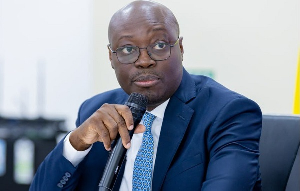
 Dr Cassiel Ato Forson is the Finance Minister
Ghana’s 2027 Budget is entering its final stages of preparation, with the government’s ongoing review of its new International Monetary Fund (IMF) Policy Coordination Instrument (PCI) arrangement emerging as a major determinant of next year’s fiscal priorities, expenditure limits and structural reforms.
The 36-month, non-financing programme, which Ghana entered after completing its three-year Extended Credit Facility (ECF) arrangement with the Fund, is expected to impose strict fiscal discipline while allowing government to pursue its ambitious infrastructure, industrialisation and job creation agenda.
The first review of the PCI, being concluded this week under Finance Minister Dr Cassiel Ato Forson and Bank of Ghana Governor Dr Johnson Asiama, is therefore a critical part of the process of aligning the 2027 fiscal framework with the country’s economic reform commitments.
Although the PCI does not provide direct financial support, its policy commitments and quantitative targets will significantly influence the government’s room for manoeuvre in determining revenue mobilisation, public expenditure and borrowing requirements.
A key requirement is the maintenance of a positive primary balance, which measures government revenue against expenditure excluding interest payments. This is intended to demonstrate the sustainability of public finances and consolidate gains made under the previous IMF-supported programme.
The 2027 Budget must consequently accommodate the government’s infrastructure ambitions under the Big Push initiative without compromising its fiscal consolidation commitments.
Revenue mobilisation is expected to remain central to this balancing act, with emphasis on broadening the tax base, improving digital tax compliance and reviewing exemptions to increase the tax-to-GDP ratio, rather than relying primarily on new tax rate increases.
Expenditure management will also be crucial, particularly in containing the public sector wage bill and ensuring that capital spending is directed towards ongoing projects, self-financing investments and infrastructure initiatives with highly concessional financing arrangements.
The government is also expected to maintain restrictions against monetary financing of fiscal deficits through central bank overdrafts.
Energy sector reforms
One of the most consequential areas of the IMF’s engagement is the energy sector, whose persistent financial challenges continue to expose public finances to significant contingent liabilities.
State-owned enterprises, particularly the Electricity Company of Ghana (ECG) and Volta River Authority (VRA), have accumulated substantial obligations that threaten to undermine fiscal consolidation efforts.
The 2027 fiscal framework is expected to give greater attention to addressing these legacy debts, strengthening the operational and financial performance of energy sector institutions and reducing the likelihood of repeated government bailouts.
The Tema Oil Refinery (TOR) has also featured in the IMF’s oversight engagements, underscoring the importance of improving governance and operational efficiency across strategic state-owned enterprises.
A tighter implementation of the Cash Waterfall Mechanism is another expected priority. The mechanism is intended to ensure that electricity revenues are transparently distributed among power producers and fuel suppliers, reducing payment arrears and preventing the accumulation of additional liabilities.
Government’s energy sector policy direction is also expected to place greater emphasis on cost-reflective tariffs to reduce the need for budgetary subsidies.
Final budget preparations
The alignment with the IMF programme represents one of the last major stages in preparing the 2027 Budget, following the Ministry of Finance’s commencement of the budget process in July.
The Ministry invited electronic submissions from the public and stakeholders until August 21, 2026, in accordance with Section 21 of the Public Financial Management Act, 2016 (Act 921).
The budget is now undergoing final Cabinet-level consideration and technical adjustments ahead of its presentation to Parliament on November 12.
Consequently, new proposals submitted by business associations at this stage are unlikely to be incorporated into the initial Budget Statement. However, organised business will still have opportunities to influence specific measures before the Appropriation and associated tax legislation are passed.
Following the presentation, the budget will be referred to parliamentary committees, including the Finance Committee and the committees responsible for Trade and Industry and Tourism, for detailed scrutiny.
Business associations can use this process to submit position papers, make representations and advocate changes to proposed tax measures and sectoral allocations.
They can also engage Members of Parliament during consideration of the accompanying tax amendment bills, while post-budget engagements with the Ministry of Finance could provide further opportunities to seek clarification or adjustments during implementation.
Another important input into the final allocations is the Ghana Statistical Service’s launch of the Ghana in Numbers 2025 report and digital portal on October 29. The platform provides economic, employment and business data intended to strengthen evidence-based policymaking.
From stabilisation to growth
The 2027 Budget is expected to mark a shift in emphasis from macroeconomic stabilisation towards an active New Economy agenda.
With inflation declining to 5.2 percent in September 2026, lower interest rates and public debt estimated at about 45 percent of GDP, government is expected to place greater emphasis on translating improved macroeconomic conditions into productive economic activity.
Local value addition, industrialisation, employment creation and infrastructure development are expected to feature prominently, alongside investments in youth employment initiatives such as the Adwumawura Programme and National Apprenticeship Programme.
Final sectoral expenditure ceilings, allocations to Ministries, Departments and Agencies, and revenue projections remain among the key technical components requiring completion. Final internal submissions for Metropolitan, Municipal and District Assemblies are expected by November 5.
The central challenge will be balancing 2027 debt-service obligations and fiscal commitments against the financing requirements of industrial development, local manufacturing and employment programmes.
The November 12 presentation will begin the parliamentary scrutiny and approval process, with the objective of securing passage of the budget before the end of the year.

Copyright © 1994 - 2026 GhanaWeb. All rights reserved.










