


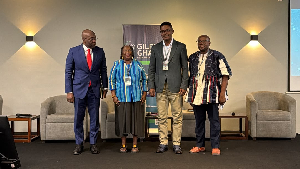
 Some of the stakeholders at the event
Former Slovak Prime Minister Eduard Heger has warned that growing political polarisation and the influence of social media algorithms are deepening divisions in society, urging leaders to promote collaboration and defend democratic values.
Speaking on the theme “Leadership, Governance & Resilience in an Age of Complexity” at the Geneva Institute for Leadership & Public Policy (GILPP) Regional Conference 2026 on November 3, 2026, Heger said the growing divisions were becoming increasingly evident in everyday relationships, including within families.
According to him, people with opposing political views sometimes avoid discussing certain issues with family members because they fear such conversations could lead to heated disagreements.
He also expressed concern about how social media algorithms tend to reward aggressive language with greater visibility, encouraging some individuals to adopt increasingly confrontational approaches to attract audiences and influence public opinion.
“The more aggressive your language is, the more viral it becomes. So it is motivating those actors to be more violent, more aggressive, just so they grow their audience and then the impact,” he said.
Chop bar operator asked me to bring saliva, genital fluids from dead persons - Suspect tells police
Heger described this as one of the negative consequences of the digital era, noting that society was yet to find an effective response to the challenge.
He cautioned leaders against assuming that the issue was solely the responsibility of politicians, stressing that it also affected institutions, companies and other organisations.
According to him, employees and people under the supervision of leaders are constantly exposed to information and opinions that shape their attitudes, which they subsequently bring into their workplaces.
“If you think it doesn't bother you because you are a leader, a regional leader, the leader of an institution, a company or a smaller office, let me tell you one thing: the people you lead are influenced by what they watch and follow. Somebody is talking to their mind, and they bring those attitudes into the workplace,” he stated.
Touching on practical leadership lessons, Heger encouraged participants to prioritise progress over perfection, arguing that meaningful change often begins with small but consistent steps.
“Always think about progress and include progress before perfection. Many people say, ‘Oh, I want to work with solutions.’ No. Believe me, progress is what you want,” he said.
He explained that people could gradually increase the pace of their efforts once they had started making progress, rather than attempting to achieve everything at once.
He also outlined other principles that should guide people in leadership positions, including putting the vision for the good of the country before personal ambition, consensus before confrontation, humility before people, and long-term results before short-term popularity.
“Many times we want to win the argument. Give it up. You don't have to win all the arguments. You don't have to win any arguments. You want to get the consensus so people get going in the right direction.”
Heger further encouraged participants not to give up in the face of difficult circumstances, urging them to remain committed to their responsibilities and continue working towards solutions.
Drawing on his experience as Slovakia's Prime Minister during the COVID-19 pandemic and the full-scale Russian invasion of neighbouring Ukraine, he said leadership often required people to navigate challenges for which they might not have been adequately prepared.
Also, Member of Parliament for Ofoase Ayirebi, Kojo Oppong Nkrumah, has raised concerns about what he described as partisan accountability in Ghana’s democracy, arguing that political affiliations often influence whether public officials are held responsible for their actions.
In a sideline interview at the GILPP Regional Conference 2026, the former Information Minister said accountability appeared to depend on which political party was in power.
He cited recent developments in Parliament, where attempts to initiate inquiries into matters of national interest had faced resistance.
“I think the major problem with accountability in our democracy is that it's partisan. Depending on who is in power, there's accountability. And depending on whose party is being asked to account, it turns a blind eye to the question of accountability,” he said.
He further criticised the position taken by the parliamentary majority on requests for inquiries, arguing that political interests should not prevent Parliament from investigating issues of public concern.
According to him, the situation reflects a broader problem in which people are reluctant to demand accountability from individuals they consider politically aligned with them.
Meanwhile, President of the Geneva Institute for Leadership & Public Policy (GILPP), Dr Henry Deneen, has expressed confidence in Ghana’s potential, describing the country as a stable nation with gifted people and a promising future.
In a sideline interview at the GILPP Regional Conference 2026, Dr Deneen said his second visit to Ghana had reinforced his belief that the country was an ideal location for the event. He noted that the institute was honoured to host the conference in Ghana and hoped its engagement would contribute to the country’s development.
“Very stable country, great people, gifted people, and that's one of the reasons that the Geneva Institute wanted to come,” Dr Deneen said.
He further explained that the conference was organised in collaboration with the institute’s local partner, Lorencia, to bring together stakeholders to discuss resilience, good governance and the principles needed to sustain democratic governance in Ghana.
According to him, the organisers expected between 80 and 90 participants, including panellists from government, the private sector and other sectors of society.
He added that the institute was pleased with the reception in Ghana and looked forward to learning from participants while contributing to conversations that could support the country's progress.
“We're hoping to have between 80 and 90 people here. I think we're going to hit that target: great panellists from every sector, government, private sector, and so forth.
“We just hope we can contribute to the betterment of the society of Ghana,” he added.
AM
SayItLoud: Newly constructed road turns Nsakina into a nightmare whenever it rains

Copyright © 1994 - 2026 GhanaWeb. All rights reserved.










