


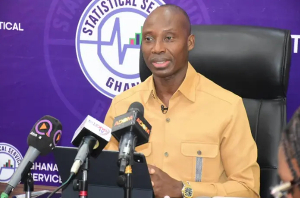
 Dr Alhassan Iddrisu is the Government Statistician
Ghana’s business population has nearly tripled over the past decade, but employment has not kept pace, with more than nine in every ten enterprises still operating informally, the Ghana Statistical Service (GSS) has disclosed.
Government Statistician Dr Alhassan Iddrisu made this known at the launch of the maiden edition of “Ghana in Numbers 2025” in Accra on Thursday last week.
According to the Service’s first Integrated Business Establishment Survey, Ghana had 2.64 million business establishments in 2024, nine in ten of which were micro businesses.
“Only 7.7% are formal. In other words, I’m talking about 92% of our businesses or enterprises being informal,” Dr Iddrisu said.
On those figures, about 203,000 businesses operate formally, while roughly 2.44 million operate outside the formal system.
Dr Iddrisu noted that establishments nearly tripled between 2014 and 2024, while the number of people working in them only doubled. This implies that the average business now employs about a third fewer people than it did a decade ago.
“Businesses are multiplying faster than the jobs inside them,” he said.
The trend reflects a pattern in which many people start small businesses because wage jobs are scarce. Such enterprises often remain one- or two-person operations, with limited capital, little access to credit and few prospects of hiring.
Although Ghana’s unemployment rate declined from 14.6 per cent in 2023 to 12.8 per cent in 2025, more than 70 per cent of jobs remain informal, often with irregular incomes and little social protection.
The publication also highlighted the scale of trade taking place outside official records. Ghana’s first survey of informal cross-border trade recorded GH¢38.4 billion worth of goods traded informally with Togo, Burkina Faso and Côte d’Ivoire.
Dr Iddrisu said the figure was equivalent to 1.4 times the trade previously recorded with the three neighboring countries. This means informal flows account for close to three-fifths of Ghana’s total trade with its immediate neighbors.
Ghana also recorded a goods trade surplus of GH¢148.3 billion in 2025, with exports exceeding imports.
“Ghana in Numbers 2025” brings together statistics on population, business, trade, social development, governance, the environment and the Sustainable Development Goals. It is supported by a web portal offering district-level data, interactive maps and downloadable statistics.
Dr Iddrisu said the publication was designed to provide a common evidence base for decision-making. “When we have our cabinets, parliaments, boardrooms, and newsrooms working from the same figures, the debate moves from whose figures are right to what do we do about them,” he said.
The findings come ahead of the presentation of the 2027 Budget on November 12, which is expected to focus on job creation. They suggest that the key challenge is not only creating new businesses, but helping existing small firms grow, formalize and employ more people.
“A statistic changes nothing until someone acts on it,” Dr Iddrisu added.

Copyright © 1994 - 2026 GhanaWeb. All rights reserved.










