


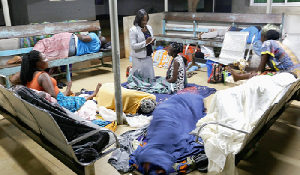
 A photo showing patients receiving treatment sitting on a chair
The ‘No Bed Syndrome’ has become one of Ghana’s most persistent healthcare challenges, particularly at major public hospitals that receive emergency cases from across the country.
The term describes situations in which patients seeking emergency treatment are turned away or referred elsewhere because hospitals claim they have no available beds or lack the capacity to provide the required care.
However, the problem is not necessarily that every hospital bed is occupied. It also involves shortages of emergency treatment spaces, inadequate medical equipment, insufficient personnel, delays in patient referrals and limited resources to manage critically ill patients.
A 2023 peer-reviewed review of the phenomenon in Ghana identified inadequate infrastructure, emergency medicines, diagnostic equipment, transport and hospital supplies among the factors contributing to the problem. It also documented instances where patients received emergency attention on floors, benches and chairs because of overcrowding.
The pressure on Ghana's hospital capacity
In March 2026, the Ghana Registered Nurses and Midwives Association (GRNMA) reported that Ghana had approximately 0.7 hospital beds per 1,000 people, citing figures it said reflected the country's limited hospital capacity.
The association also referred to an estimated national bed count of 19,907 recorded in 2015 and warned that some major hospitals were operating at occupancy levels of between 120 and 150 per cent.
These figures were presented by the association as evidence of the pressure on the country's healthcare infrastructure. The 2015 national bed count should, however, not be mistaken for a verified current national total.
Korle Bu's emergency capacity
One of the clearest examples of the challenge is Korle Bu Teaching Hospital in Accra.
According to information released by the Information Services Department following the President's announcement, Korle Bu has a functional bed capacity of 1,500 but only 65 beds in its Accident and Emergency Department.
The government's proposed target of at least 150 emergency beds would therefore more than double the department's existing capacity.
This provides a practical indication of the difference between a hospital's overall bed capacity and the number of beds available to receive emergency patients.
Digital bed management initiative
The government is also pursuing digital solutions to improve emergency referrals.
In October 2026, the Ministry of Health disclosed that more than 650 hospitals had been captured in the bed management system, with over 5,000 beds mapped for monitoring and regular updates.
The pilot involves selected teaching hospitals, the Greater Accra Regional Hospital, the University of Ghana Medical Centre and the National Ambulance Service.
The system is designed to provide information on bed availability, ambulance movements and the capacity of hospitals to receive patients.
The effectiveness of the initiative will depend on how regularly hospitals update their information and whether the facilities identified as available have the staff, equipment and specialist services needed to manage incoming patients.
The wider emergency care debate
The Ghana Medical Association has also called for an Emergency Care Act to establish minimum standards for emergency treatment, strengthen referral arrangements and provide a clearer framework for financing emergency services.
At the association's 68th annual conference, its president, Professor Ernest Yorke, argued that patients and their families should not be left moving from one hospital to another in search of emergency treatment.
The proposed legislation reflects a wider concern that solving the problem will require more than increasing the number of beds. It will also require clear responsibilities for hospitals, adequate funding, improved emergency transportation and accountability in patient referrals.
EA

Copyright © 1994 - 2026 GhanaWeb. All rights reserved.










