


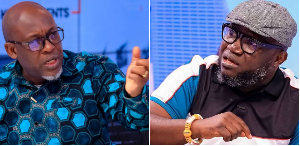
 L-R: Kofi Bentil and Ken Ashigbey
The Chief Executive Officer of the Ghana Chamber of Mines, Dr Kenneth Ashigbey, has pushed back against claims by policy analyst Kofi Bentil regarding Gold Fields’ mining operations and lease in Tarkwa.
Ashigbey has accused Bentil of misleading the public with what he describes as selective figures, arguing that the financial contribution of mining companies should be assessed based on their overall investments, statutory payments, taxes, royalties and environmental obligations.
In a statement issued on November 10, 2026, Ashigbey said isolating individual figures from mining agreements without considering the broader financial commitments could give a distorted picture of the value mining companies bring to Ghana.
The disagreement follows concerns raised by Bentil over the initial US$30,000 consideration fee for Gold Fields’ mining lease and the company's reported financial commitments over its years of operation.
Responding to the issue, Ashigbey explained that the US$30,000 was a standard provision in mining lease agreements at the time and did not represent the total amount paid by Gold Fields to acquire and maintain its mining rights.
He said the company also pays statutory charges, including processing fees, mineral rights fees and ground rent, which are separate from the contractual consideration.
Ashigbey also disputed Bentil’s reference to approximately US$30 billion in cumulative gross revenue generated by the mine over three decades.
He described the figure as doubtful and argued that gross revenue should not be confused with profit, given the significant operational costs associated with mining.
According to him, expenses such as capital investment, fuel, machinery, taxes and wages must be considered before determining the actual profits made by the company.
He further indicated that approximately 74 percent of every dollar generated by Gold Fields remains in Ghana through corporate taxes, royalties, dividends, wages, local procurement and community projects.
On the company's investments, Ken Ashigbey acknowledged that Gold Fields had made substantial financial commitments to its operations but maintained that these investments had also created economic benefits for Ghana.
He cited the government's 10 percent free-carried interest in the mine, employment opportunities, local procurement, royalties and taxes as some of the benefits accruing to the state and host communities.
A major issue in the disagreement is the rehabilitation of mining sites after years of operations.
Bentil had raised concerns about who would bear the cost of reclaiming the open-pit mining areas after decades of extraction.
However, Ashigbey said Gold Fields was legally required to undertake progressive land reclamation and had spent approximately US$46 million on rehabilitation activities since 2016.
He said the company had an average annual rehabilitation expenditure of US$4.2 million and had maintained a Reclamation Security Agreement with the Environmental Protection Authority (EPA) since 2003.
Ashigbey further disclosed that, as of December 2025, the estimated mine closure liability stood at US$107.19 million.
He said Gold Fields currently holds a US$83.9 million closure bond with Absa Bank Ghana and is allocating US$500,000 monthly towards meeting the updated closure liability.
On the renewal of Gold Fields’ mining lease, the Chamber of Mines CEO argued that the company should be granted a renewal if it has satisfied the statutory and contractual requirements.
He said failing to honour the provisions of the country's mining laws could undermine investor confidence and affect the future of the mining industry.
Ashigbey, however, called for any lease renewal to provide an opportunity to review the economic, social and environmental terms to ensure that Ghana and host communities receive fair value from mining operations.
“The choice is not between protecting Ghana's interests and respecting investors' rights. We must do both,” he stated.
ID/MA

Copyright © 1994 - 2026 GhanaWeb. All rights reserved.










