


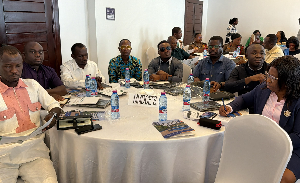
 MMDCEs seated at the training workshop
The Minister of the Interior,Muntaka Mohammed-Mubarak, has urged Metropolitan, Municipal and District Chief Executives (MMDCEs) in the Western and Western North Regions to strengthen collaboration with intelligence officers and community stakeholders.
He said effective local security management required MMDCEs to work closely with security and intelligence agencies, opinion leaders and community members to identify emerging threats and address them before they escalated.
Mohammed-Mubarak was speaking at a training workshop organised by the National Security Council Secretariat (NSCS) in Takoradi to equip MMDCEs with a better understanding of the Security and Intelligence Agencies Act, 2026 (Act 1168), and its implications for local security management.
He expressed concern about the poor attendance and lateness of some MMDCEs, saying such attitudes could undermine their working relationships with security heads and affect the effective management of security matters.
Mohammed-Mubarak questioned how MMDCEs could effectively represent the President in their respective districts if they failed to demonstrate commitment to important security engagements.
He said Act 1168 introduced a framework for strengthening the coordination, management and oversight of the country’s security and intelligence institutions.
The Minister said security remained fundamental to national development, as it protected lives, safeguarded investments, supported economic activities and created an enabling environment for communities to thrive.
He said maintaining national security required more than responding to incidents after they occurred, but also demanded effective leadership, timely intelligence, preventive action and close cooperation among institutions responsible for protecting the country.
Mohammed-Mubarak said the Western Region occupied a strategic position in Ghana’s economy, given its coastline and international maritime boundary with Côte d’Ivoire, as well as the presence of the Takoradi Port, offshore petroleum industry and major energy installations.
He said protecting those strategic assets and surrounding communities required constant vigilance, effective maritime and border surveillance, reliable intelligence and strong coordination among relevant security agencies.
The Minister also identified the Western North Region’s proximity to Côte d’Ivoire as presenting distinct security challenges, requiring effective border management and cooperation with border communities.
George Loh, the Director, Legal at the NSCS, said the workshop was intended not merely to familiarise participants with the law but also to translate its provisions into improved upon intelligence coordination, clearer institutional responsibilities and more effective responses to security threats.
He said Regional Ministers and MMDCEs needed to understand their respective roles, while security and intelligence agencies were expected to contribute their expertise, share relevant information through appropriate channels and respect each other’s lawful mandates.
“Information must lead to assessment. Assessment must inform decisions, and decisions must lead to appropriate action,” he said.
The workshop examined Ghana’s current national and regional security threat landscape, practical approaches to addressing security threats, the constitutional framework underpinning Act 1168, immediate action requirements, and accountability and oversight obligations.
It was expected to strengthen participants’ understanding of their statutory responsibilities, improve intelligence-sharing and institutional cooperation, and enhance their capacity to identify emerging security threats before they escalated.

Copyright © 1994 - 2026 GhanaWeb. All rights reserved.










