


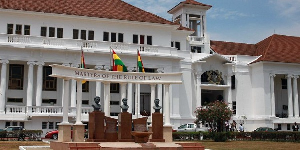
 A photo of Supreme Court of Ghana
Ghana’s political landscape was thrown into uncertainty on November 12, 2024, when the Supreme Court overturned Speaker of Parliament Alban Bagbin’s declaration of four parliamentary seats vacant, restoring the New Patriotic Party’s (NPP) slim majority in the 8th Parliament just weeks before the December 7 general election.
The landmark 5–2 decision brought an intense political and constitutional battle to a decisive moment, preventing the opposition National Democratic Congress (NDC) from retaining the parliamentary majority it had briefly claimed following the Speaker’s October declaration.
At the centre of the dispute was a question that threatened to alter the balance of power in Parliament: Could Members of Parliament vacate their current seats simply by choosing to contest a future election on the ticket of a different political party or as independent candidates?
The controversy began on October 17, 2024, when Speaker Alban Bagbin declared four parliamentary seats vacant, relying on Article 97(1)(g) and (h) of Ghana’s 1992 Constitution.
The affected lawmakers were Cynthia Mamle Morrison, the NPP MP for Agona West; Kwadjo Asante, the NPP MP for Suhum; Peter Yaw Kwakye-Ackah, the NDC MP for Amenfi Central; and Andrew Amoako Asiamah, the independent MP for Fomena.
The first three lawmakers had filed to contest the December 2024 parliamentary elections as independent candidates, while Amoako Asiamah had chosen to contest on the NPP ticket.
Bagbin maintained that their decisions amounted to a change in political identity, which under the constitutional provisions meant they had forfeited their seats.
Article 97(1)(g) provides for an MP to vacate a seat if the member leaves the political party under which they were elected to join another party or remain in Parliament as an independent member. Clause (h) addresses an independent MP who subsequently joins a political party.
The Speaker’s decision immediately changed the parliamentary numbers. The NDC claimed 136 seats against the NPP’s 135, giving the opposition a one-seat advantage and threatening to overturn the existing parliamentary arrangement.
The development also triggered a fierce political confrontation between the two major parties, with the interpretation of the Constitution becoming a central issue in the struggle for parliamentary control.
However, the Supreme Court intervened after Alexander Afenyo-Markin, then Majority Leader and MP for Effutu, challenged the Speaker’s decision.
The court first stayed the implementation of the declaration on October 18, 2024, before proceeding to hear the substantive constitutional case.
The case was heard by a seven-member panel presided over by Chief Justice Gertrude Sackey Torkornoo. Five justices ruled in favour of Afenyo-Markin, while Justices Avril Lovelace Johnson and Issifu Omoro Tanko Amadu dissented.
In announcing the decision, the Chief Justice said: “In a 5-2 majority decision, the plaintiff action succeeds.” The court did not immediately provide its full reasoning, indicating that the detailed judgment would follow.
The central issue was whether the constitutional provisions applied to MPs seeking to change their political affiliation for the next Parliament or only to those who changed their political allegiance while seeking to retain their seats during the same parliamentary term.
When the full 109-page judgment was subsequently released, the court explained that Article 97(1)(g) and (h) was intended to prevent lawmakers from changing their political allegiance while continuing to occupy their seats during the same four-year parliamentary term.
The court reasoned that an MP who decides to contest a future election under a different political identity does not automatically forfeit their current parliamentary seat.
In its judgment, the court stated:
“The central issue thus intended to be addressed by Article 97(1)(g) and (h), is not merely declaring the intention to join another party or the intention to become an independent MP in another Parliament, but becoming Independent or becoming a member of another party while seeking to remain in Parliament during the term for which the MP was elected.”
It further explained that changing political allegiance while remaining in Parliament violated the understanding between an elected representative and the electorate.
The court added: “If an MP wishes to change their political status while remaining in Parliament, they must vacate their seat and seek a new mandate from the voters.”
The decision effectively restored the NPP's parliamentary advantage, with the party holding 138 seats, including the independent MP aligned with it, against the NDC's 137 seats, according to contemporary reporting.
The ruling came at a particularly sensitive period in Ghana's political history. With the December 7, 2024 general election approaching, control of Parliament had become another major battleground for the two dominant political parties.
The controversy had also brought parliamentary business to a standstill, with the House adjourned indefinitely following the Speaker's declaration. The court's intervention therefore went beyond determining the status of four lawmakers; it addressed a constitutional dispute with immediate implications for parliamentary representation and the balance of political power.
For the NPP, the judgment meant retaining its narrow control of the 8th Parliament as it prepared for a fiercely contested general election. For the NDC, it meant losing the temporary numerical advantage it had gained following Bagbin's declaration.
The November 12, 2024 ruling remains one of the defining constitutional and political episodes of Ghana's 8th Parliament, illustrating how the interpretation of a few constitutional provisions could bring the country's legislature to a standstill and place the balance of power between two major political parties in the hands of the Supreme Court.
It was a ruling that settled the immediate parliamentary numbers, but also left a lasting mark on discussions about party loyalty, parliamentary independence, constitutional authority and the relationship between elected representatives and the people who vote them into office.
EA

Copyright © 1994 - 2026 GhanaWeb. All rights reserved.










