



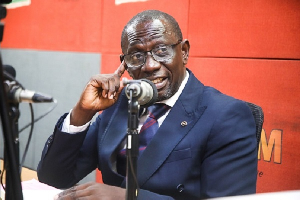
 Frederick Opoku is the Acting Commissioner of the Rent Control Department
For decades, Ghana’s rental housing sector has operated under a system in which tenants frequently complain of excessive rent charges, arbitrary increases, demands for years of rent in advance and what they describe as exploitation by some landlords.
Despite the existence of laws intended to regulate the sector, enforcement has often remained a major challenge, leaving many tenants with little knowledge of their rights and limited avenues for redress.
But one man appears determined to change that narrative.
He is Frederick Opoku, the Acting Commissioner of the Rent Control Department, who has emerged as one of the most vocal advocates for stricter enforcement of Ghana’s rent laws.
Since assuming office, Opoku has taken an unusually assertive approach to rent regulation, confronting landlords, challenging private hostel operators and demanding that property owners operate within the confines of the law.
His approach has generated public attention, sparked disagreements with industry players and placed the activities of the Rent Control Department firmly in the national conversation.
For many tenants, his interventions represent a long-awaited attempt to make rent regulation meaningful.
For some property owners and hostel operators, however, his approach has raised questions about the manner in which the department intends to exercise its regulatory powers.
From critic to head of Rent Control
Interestingly, Opoku's journey into rent regulation comes with an admission that he was once among those who questioned the effectiveness of the institution he now leads.
In an interview with ChannelOne TV on May 8, 2026, he disclosed that before assuming office, he had frequently criticised the Rent Control Department, even describing it as a "toothless bulldog".
However, he said his perception changed after gaining first-hand experience of the challenges confronting the institution.
2,000 task force personnel to enforce Ghana's rent laws
He discovered that the department's limitations were not necessarily due to a lack of willingness among its personnel to work but rather to severe logistical and institutional constraints.
According to him, the department operates 16 offices across the country with only two vehicles.
The situation, he explained, makes it extremely difficult for officers to conduct property inspections, investigate complaints and undertake rent assessments across the country.
His admission offered an unusual glimpse into the difficulties confronting an institution expected to regulate an entire country's rental market with limited resources.
A reform agenda beyond warnings
Rather than limit his interventions to public warnings, Opoku has outlined a broader reform agenda intended to transform the operations of the Rent Control Department.
In February 2026, he announced plans to strengthen enforcement and compliance, improve the registration of landlords and tenants, intensify public education and build stronger institutional partnerships.
A key component of the proposed reforms is the creation of a comprehensive database containing information on rental properties, landlords, tenants and tenancy agreements.
The department also intends to introduce standardised tenancy agreements for residential and commercial properties to improve transparency and reduce disputes between landlords and tenants.
The reforms are also expected to involve more inspections, the reorganisation and training of rent taskforces and collaboration with local authorities and other state institutions.
For Opoku, the objective is to move rent regulation beyond the traditional approach of responding to complaints and towards a system where rental transactions are properly documented and monitored.
Taking on landlords over arbitrary rent increases
One of the issues that has repeatedly attracted Opoku's attention is the practice of landlords increasing rent without following the legally prescribed procedures.
Rent Commissioner threatens legal action against UGEL, private hostels over rent hikes
In May 2026, he criticised landlords who justify rent increases using fluctuations in the exchange rate and rising prices of building materials, including cement and iron rods.
He argued that property owners who had failed to maintain or improve their buildings over several years could not simply use rising construction costs as an excuse to increase rental charges.
He insisted that landlords must demonstrate the basis for proposed increases and submit their properties for the necessary assessment.
His position is that property ownership does not give landlords unrestricted authority to determine rental charges.
"No landlord has any right whatsoever to sit at will and increase your rent. It is illegal," he stressed in an interview with ChannelOne TV.
He has maintained that rent adjustments must be supported by appropriate assessments rather than decisions based on prevailing market prices or what neighbouring landlords are charging.
The hostel industry becomes his biggest battleground
Perhaps the most prominent confrontation in Opoku's enforcement campaign has been his attempt to bring private hostel operators, particularly those serving tertiary students, under stricter regulatory supervision.
The intervention followed growing concerns over the cost of student accommodation, with the National Union of Ghana Students (NUGS) appealing to the Rent Control Department to intervene.
In response, Opoku announced plans to inspect private hostels and assess their facilities and pricing structures.
He subsequently directed hostel operators to suspend intended increases in accommodation charges until their facilities had been assessed.
His argument was straightforward: private hostel operators were not exempt from Ghana's rent laws simply because they had invested substantial amounts of money in constructing their facilities.
He maintained that the Rent Control Department had the legal authority to regulate private premises, including hostels, with government-owned properties being the exception.
The position did not sit well with some operators.
On August 19, 2026, Opoku engaged in a heated discussion on Joy FM's Super Morning Show with the Chairman of the Hostel Owners Association, Bishop Dr Akwasi Owusu-Bi.
The disagreement centred on the department's approach to regulating private hostels and whether its proposed interventions adequately considered the financial realities confronting operators.
Owusu-Bi accused the commissioner of adopting the wrong approach and questioned his willingness to engage the association.
He also alleged that an attempt to invite Opoku to Kumasi for discussions had ended in disagreement over who should bear his travel expenses.
Opoku defended his position, explaining that he could not use public funds to attend a meeting organised by a private association without an approved budget.
He maintained that hostel operators could instead travel to Accra to engage the department.
Despite the disagreement, he remained firm that private hostel operators must comply with the law.
100 hostels on his assessment table
Opoku's determination to regulate student accommodation has also translated into concrete administrative measures.
In August 2026, he disclosed that the department had received approximately 100 applications from private hostel operators for rent assessment.
He indicated that the facilities would be assessed within two to three months to determine appropriate charges.
He also warned operators who had not registered their facilities to do so or risk prosecution.
Under the provisions of Ghana's Rent Act, 1963 (Act 220), landlords and hostel operators are required to comply with applicable rent assessment and documentation requirements.
Opoku has also reminded operators of their obligation to issue rent cards and enter into proper tenancy agreements with occupants.
He warned that failure to issue the required documentation could attract a minimum fine of 200 penalty units, a six-month prison term or both.
For students who often find themselves at the mercy of hostel operators during admission periods, the proposed measures could provide a stronger basis for challenging unfair rental practices.
He wants landlords and tenants to face the law
Beyond hostel regulation, Opoku has also turned his attention to the widespread practice of demanding excessive rent advances.
Under Section 25(5) of the Rent Act, 1963 (Act 220), landlords are prohibited from demanding more than six months' rent in advance for tenancies exceeding six months.
However, the practice of demanding one or two years' rent in advance remains a major concern for prospective tenants, particularly young workers and people relocating to major cities.
In an October 28, 2026 interview on JoyNews Prime, Opoku announced plans to deploy a 2,000-member taskforce, dubbed Yellow Yellow, in the first quarter of 2027.
The taskforce is expected to enforce compliance with rent regulations, including the six-month advance payment limit.
He explained that his initial approach had focused on educating landlords and tenants about their legal obligations before moving into a more aggressive enforcement phase.
He said he had spent his first 10 months in office undertaking public education and sensitisation.
"Now there's a standby 2,000 rent task force called Yellow Yellow. That next year, by first quarter, we are going to deploy 2,000 young men, and that's where you see a full enforcement of the law," he announced.
The proposed deployment could mark a significant shift in the department's operations if adequately resourced and implemented.
Seeking specialised courts to prosecute offenders
Another major part of Opoku's reform efforts is the proposed establishment of specialised rent courts.
In May 2026, he disclosed that the department had begun engagements with the Judicial Service of Ghana to explore the establishment of specialised courts to handle rent-related offences.
The proposal is intended to improve the prosecution of landlords and other property owners who violate the country's rent regulations.
He also announced plans to develop a comprehensive database of landlords, tenants and rental properties to improve monitoring and information-sharing among state institutions.
From 'Toothless Bulldog' to Apology: Acting Rent Commissioner retracts past criticisms
For Opoku, the challenge is not necessarily the absence of laws but the failure to enforce existing provisions.
His position is that the country cannot continue to maintain rent regulations on paper while allowing widespread violations to go unchallenged.
His own institution needs saving
But while Opoku has been demanding accountability from landlords and hostel operators, he has also been forced to confront the weaknesses within the institution he heads.
The revelation that 16 Rent Control offices nationwide operate with just two vehicles raises questions about how effectively the department can carry out the extensive inspections and enforcement exercises he has promised.
He has also publicly appealed to President John Dramani Mahama to provide the department with adequate funding, logistics, equipment and office accommodation.
In September 2026, he said the department lacked the resources required to sustain its crackdown on unlicensed hostels.
"Mr President, you appointed me to work, so I should be resourced to work. I cannot do this job effectively without the necessary resources," he appealed.
The statement highlighted an important contradiction in his campaign: while he is promising tougher enforcement against landlords and hostel operators, the institution expected to carry out that enforcement is itself struggling with inadequate resources.
The lone soldier or the beginning of a new era?
Frederick Opoku's emergence as a vocal figure in Ghana's rental housing debate has brought renewed attention to an institution that many tenants have long considered ineffective.
His confrontational exchanges with hostel operators, warnings to landlords and proposed deployment of a 2,000-member taskforce suggest an administration determined to move beyond public education towards stricter enforcement.
However, the success of his campaign will not be measured by the number of warnings issued, media interviews granted or confrontations with property owners.
It will ultimately depend on whether tenants can secure accommodation without being subjected to unlawful demands, whether landlords receive fair treatment under the law and whether rent disputes can be resolved promptly.
There is also the question of whether the government will provide the financial and logistical support necessary to make his ambitious plans achievable.
Ghana's rental market needs regulation, but it also needs a system that protects legitimate property investments while ensuring that tenants are not exploited.
For now, Opoku appears determined to take on that responsibility, even as he battles institutional weaknesses and resistance from sections of the property industry.
Whether he will become the man who finally gives Ghana's rent laws the enforcement they have lacked for decades remains to be seen.
MRA/BAI
Who Is Responsible for Stray-Bullet Injuries and Deaths?

Copyright © 1994 - 2026 GhanaWeb. All rights reserved.










