


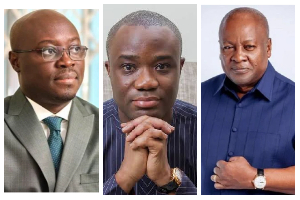
 Ato Forson is the finance minister (L) Kwakye Ofosu (M) and Mahama (/R)
Minister of Government Communications and Member of Parliament for Abura-Asebu-Kwamankese, Felix Ofosu Kwakye, has clarified the distinction between the National Democratic Congress (NDC) government’s 24-hour economy initiative and its proposed New Economy programme.
Speaking in an interview with Joy News ahead of the 2027 budget reading in parliament on November 12, 2026, Ofosu Kwakye explained that although the two programmes may have some areas of overlap, they are fundamentally different in their objectives, implementation and scope.
According to him, the 24-hour economy is primarily a private sector-led initiative designed to encourage businesses to operate around the clock through government incentives, thereby expanding business activities and creating additional employment opportunities.
He explained that the initiative seeks to support private businesses to introduce shift systems and extend their operating hours, allowing them to maximise productivity while employing more people.
“The 24-hour economy, even though it is a government initiative, is primarily aimed at the private sector. So, the government said that we think this economy can work in a manner that it does not sleep and that it can run around the clock. To be able to do that, we need to provide incentives to private sector companies, mostly, who can then take advantage of it, expand their businesses, and in the process employ more people,” he said.
Ofosu Kwakye disclosed that about 33 major private businesses and companies had registered with the 24-hour economy secretariat, with some already implementing the initiative ahead of the government's announcement of incentives.
He further cited some public institutions that have introduced round-the-clock operations and shift systems, noting that the initiative was already contributing to employment creation.
He mentioned the Ghana Ports and Harbours Authority (GPHA), the Ghana Publishing Company Limited and the Driver and Vehicle Licensing Authority (DVLA) as examples of institutions implementing aspects of the programme.
According to him, the GPHA has introduced a shift system that allows customers to clear their goods even during the night, resulting in the employment of an additional 1,400 workers.
He also indicated that the Ghana Publishing Company Limited had managed to retain 100 workers who would otherwise have been laid off by introducing a shift system under its new management.
Turning to the New Economy programme, Ofosu Kwakye said it was a long-term government initiative focused on restructuring Ghana’s economy through strategic investments in selected growth sectors.
He explained that the programme would involve setting aside $10 billion to finance specific growth pillars, with the ultimate objective of transforming the economy from one heavily dependent on raw materials into a value-added economy capable of generating sustainable and quality employment.
“The new economy is a government programme lasting for years, through which 10 billion dollars will be set aside to finance specific growth pillars to transform the structure of our economy, make us a value-added economy and also ensure that through the process we create quality jobs for Ghanaians,” he stated.
Here are the 9 charges court has ordered Adu-Boahene, wife to open defence for
He further explained that the New Economy programme was designed to address Ghana’s recurring economic difficulties by promoting consistent investment in critical sectors, improving economic stability and raising the standard of living of citizens.
According to him, the programme seeks to break the cycle of economic crises that has repeatedly forced the country to seek assistance from the International Monetary Fund (IMF).
“The new economy essentially revolves around government investment in critical areas that will ensure that we grow our economy on a consistent, more reliable, predictable basis and then through that churn out quality jobs for the teeming youth of this country.
“Through that also, we give our people a much better standard of living, and then move away from this perennial, cyclical economic crisis that we fall into,” he said.
Ofosu Kwakye stressed that the two initiatives should not be confused, explaining that while the 24-hour economy is primarily intended to stimulate private sector activity through incentives, the New Economy programme is a long-term government investment strategy aimed at fundamentally transforming the structure of Ghana’s economy.
AM
Samira Bawumia Stuns Audience with ‘Asaase Yaa’ Poem at Literary Night

Copyright © 1994 - 2026 GhanaWeb. All rights reserved.










