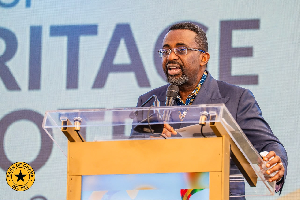
 Dr Johnson Pandit Asiama is the Governor of BoG
The Bank of Ghana (BoG) expects inflation to rise back into its 6–10 per cent target band in the coming quarters, up from 5.5 per cent in October. It is the clearest sign yet that the central bank is in no hurry to resume cutting interest rates when its Monetary Policy Committee (MPC) meets next week.
Governor Dr Johnson Pandit Asiama told Parliament’s Committee on Economy and Development last Friday that, although inflation had risen from its March low, it remains below the medium-term target band.
“We expect inflation to move into the target band in the coming quarters, although the timing will depend on the evolution of domestic and external price pressures,” he said.
The statement came a week before the MPC begins its final meeting of the year, from November 16 to 18. It amounts to a public forecast that prices will rise faster from here on. Central banks that expect higher inflation rarely cut rates, so the Governor’s message points firmly to a hold.
Dr Asiama named the risks behind the Bank’s caution: crude oil prices above US$100 a barrel, interest rate increases by the US Federal Reserve and the European Central Bank, and the potential effects of a strong El Niño weather phenomenon. Together, they could push up imported fuel costs, affect capital flows into frontier markets such as Ghana, and disrupt domestic food supply.
Inflation has risen for four straight months, from 4.6 per cent in July to 5.0 per cent in August, 5.2 per cent in September and 5.5 per cent in October. Data released last Wednesday showed that services inflation alone reached 11.5 per cent, already above the top of the band.
The policy rate has been at 14.0 per cent since March. The MPC cut it by 250 basis points in January and a further 150 basis points in March, then paused in May as the Middle East conflict pushed up oil prices and utility tariffs were adjusted. It held the rate in July and September.
The Governor described the May pause as “a deliberate and forward-looking decision”. He told the Committee that managing inflation expectations is as important as the policy rate itself. Policy, he said, “responds to the evolving outlook rather than follows a predetermined path”.
The caution is backed by a strong scorecard on the easing already done. By June, the average lending rate had fallen to 15.6 per cent from 27.0 per cent a year earlier. Over the same period, the 91-day Treasury bill rate dropped from 14.7 per cent to 5.3 per cent, and private sector credit growth strengthened to 41.2 per cent.
Real GDP grew by 6.4 per cent in the first quarter and 6.0 per cent in the second. Ghana posted a trade surplus of US$8.81 billion and a current account surplus of US$5.1 billion in the first half of the year.
The fiscal side has also supported monetary policy. The overall deficit was estimated at 0.4 per cent of GDP in the first half, against a target of 2.0 per cent, while public debt stood at about 45.0 per cent of GDP.
Reserves are where the pressure shows. Gross international reserves stood at US$13.8 billion, or 5.7 months of import cover, at the end of 2025. They fell to US$11.07 billion, or 4.2 months, at the end of August, before recovering to US$12.05 billion, or 4.5 months, by September 22.
The gap matters because of the target the Bank has set itself. The Ghana Accelerated National Reserve Accumulation Programme (GANRAP), operational since April, aims for 15 months of import cover by 2028. That is more than three times the current level, an ambitious goal with little more than two years to run.
The cedi depreciated by 7.9 per cent against the dollar in the first half and by 9.5 per cent by September 18. Dr Asiama attributed the slide to energy-related import payments, dividend repatriation and global risk aversion, following the cedi’s 40.7 per cent appreciation in 2025. He said volatility in the first half was lower than in the same period of each of the previous four years.
He also outlined an overhaul of how the Bank intervenes in the currency market. Interventions now come through pre-announced windows with clearer communication of volumes, follow rules-based triggers that reduce discretion, and are backed by forward guidance on when the Bank will not step in. The aim is to give exporters, importers and banks a more predictable basis for planning and hedging.
The Bank has also replaced the dynamic cash reserve ratio with a uniform 20 per cent ratio held in cedis, a change that has cut its sterilisation costs.
The banking sector continued to strengthen. Total assets grew by 30.7 per cent to GH¢502.4 billion, and the capital adequacy ratio stood at 20.4 per cent. The non-performing loans ratio fell from 23.1 per cent in June 2025 to 16.1 per cent in June 2026 and 15.7 per cent in August. That still leaves banks well short of the BoG’s 10 per cent target, with the December deadline about seven weeks away.
The Governor ended with a warning. With global oil prices, exchange rate movements and domestic price adjustments all in play, he said, the Bank will “take the necessary policy actions to safeguard price stability.”

Copyright © 1994 - 2026 GhanaWeb. All rights reserved.