


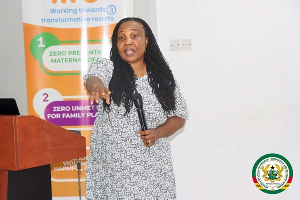
 Bernice Sam was the facilitator for the event
The Ministry of Local Government, Chieftaincy and Religious Affairs (MLGCRA), in collaboration with the United Nations Population Fund (UNFPA), is strengthening the capacity of faith-based organisations to address adolescent reproductive health challenges, gender-based violence (GBV) and harmful practices, including child marriage.
The initiative forms part of efforts to promote structured engagement with religious leaders and equip them with practical guidelines to support the protection of women, girls and young people in their communities.
This came to light at a two-day Trainer-of-Trainers (ToT) workshop on the Guidelines for Engaging Faith-Based Organisations on Adolescent Reproductive Health, Gender-Based Violence and Harmful Practices, including Child Marriage, which commenced on Thursday, November 12, 2026, at Hillview Guest Centre, Teiman-Abokobi.
In a speech delivered on behalf of the Ministry, the Chief Director, Alhaji Amin Abdul-Rahman, underscored the influential role of religious leaders in shaping attitudes, values and behaviours within communities.
He noted that religious leaders remained among the most trusted voices in society and were therefore important partners in promoting human dignity, protecting vulnerable persons and addressing social challenges such as teenage pregnancy, domestic violence and child marriage.
Alhaji Rahman explained that the guidelines provided a structured framework for strengthening collaboration between public institutions and religious bodies, ensuring that engagements were culturally sensitive, evidence-based and aligned with national laws and policies.
The Chief Director encouraged participants to actively engage in the training, share experiences and develop action plans to translate the knowledge acquired into practical interventions within their respective religious institutions and communities.
In his remarks, the National Programme Officer of UNFPA, Faisal Bawa, noted that the guidelines were developed to provide a common and coordinated approach to engaging faith-based leaders.
According to him, although religious leaders had been engaged over the years, the need had arisen for a standard guide to ensure that institutions and individuals working with them adopted a consistent approach.
According to him, faith-based leaders were critical partners because of their ability to mobilise community members and interpret religious teachings, making their involvement essential in addressing harmful practices and negative interpretations of religious texts.
Mr Bawa said the training was intended to equip representatives of major faith-based organisations with the skills to cascade the guidelines to their leadership structures, congregations and youth groups.
He expressed the hope that the initiative would contribute to protecting the rights of women and young people, enabling them to pursue their social and economic development and contribute to national growth.
Also speaking at the workshop, the Head of the Child Marriage Unit at the Ministry of Gender, Children and Social Protection (MoGCSP), Saphia Taminu, called for stronger involvement of faith-based leaders in addressing gender-based violence, including child, early and forced marriage.
She observed that religious leaders played significant roles in influencing family decisions, interpreting religious teachings and shaping community values, making their participation essential in challenging social and cultural norms that perpetuate harmful practices.
Taminu urged participants to regard the guidelines as practical tools for action, particularly in preventing gender-based violence, identifying cases early, referring survivors to appropriate support services and promoting community sensitisation.
She further called for stronger partnerships to ensure that religious institutions became safe spaces that uphold dignity, equality, protection and the rights of every woman, girl and child.
Through the training, representatives of participating faith-based organisations are expected to transfer the knowledge and skills acquired to their respective institutions and communities, extending the reach of the guidelines and strengthening collective efforts to address harmful practices across the country.
“We Like the Design, Release It Now” – Ghanaians React to New Currency Notes

Copyright © 1994 - 2026 GhanaWeb. All rights reserved.










