


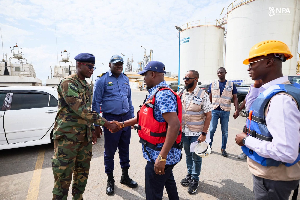
 Officials of National Petroleum Authority among other stakeholders
Fuel discharge operations at the Tema oil jetty have increased following the introduction of round-the-clock berthing and unberthing of vessels, a move facilitated by the National Petroleum Authority (NPA).
The Ghana Petroleum Mooring Systems Company Limited (GPMS) began the 24-hour operations last year after resolving technical challenges and upgrading lighting and security arrangements at the facility.
GPMS Operations and Maintenance Manager, Francis Owusu, said the improvements had enabled vessels to berth and depart at any time, helping to improve the efficiency of operations.
He made the disclosure on Thursday during a visit by civil society organisations to the company’s offshore mooring facilities, including the Single Point Mooring (SPM), Conventional Buoy Mooring (CBM) and oil jetty in Tema.
The NPA led the process in collaboration with the Ghana Ports and Harbours Authority and the Ghana Standards Authority. NPA Chief Executive, Godwin Kudzo Tameklo, said the jetty previously could not accommodate vessels after 5 p.m., leaving ships waiting in queues to discharge their products.
The CBM facility, located about 2.7 nautical miles from the Tema Fishing Harbour, uses four permanent mooring chains anchored to the seabed to keep vessels secured and stationary.
The multi-purpose oil jetty handles the discharge and loading of several petroleum products, including crude oil, fuel oil, aviation turbine kerosene, gasoil, gasoline, naphtha and liquefied petroleum gas.
Speaking on behalf of the visiting civil society groups, Executive Director of the Institute for Energy Policy and Research, Kwadwo Opoku, commended the NPA Chief Executive for maintaining an open-door policy that provides stakeholders with deeper insight into operations in the downstream petroleum sector.

Copyright © 1994 - 2026 GhanaWeb. All rights reserved.










