



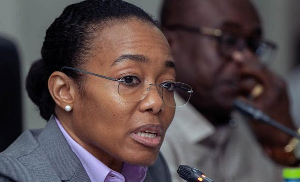
 Dr Zanetor Agyeman-Rawlings is the Minister for Environment, Science, Technology and Innovation
Ghana has called on African countries to unite and demand fairer terms in the global trade of critical minerals, insisting that the continent must benefit meaningfully from the resources driving the world's green energy transition.
The Minister for Environment, Science, Technology and Innovation (MESTI), Dr Zanetor Agyeman-Rawlings, made the call during the Africa Day Ministerial Segment at the 31st United Nations Climate Change Conference (COP31) in Antalya, Türkiye, on November 14, 2026.
Speaking on behalf of Ghana, which chairs the African Group of Negotiators, Dr Agyeman-Rawlings stressed the need for a united African position on mineral extraction, climate financing and environmental protection.
Addressing African ministers, African Union officials and other delegates, she noted that the continent was among the regions experiencing the devastating effects of climate change, including floods, droughts, drying rivers and water pollution.
“Water is where Africa feels climate change first: floods in our cities, droughts in our savannahs, rivers drying up or poisoned,” she stated.
Dr Agyeman-Rawlings further emphasised that early warning systems could only save lives if they were supported by timely funding and practical interventions at the community level.
She also highlighted Africa's strategic importance to the global transition towards clean energy, noting that the continent holds approximately 30 per cent of the world's critical mineral reserves, including significant deposits of cobalt and platinum group metals.
According to her, these resources are essential for manufacturing electric vehicles, batteries, wind turbines and solar panels needed to achieve global net-zero targets.
“Without Africa, there will be no green transition,” she declared.
However, the minister expressed concern that despite the importance of Africa's mineral resources to the global economy, mining activities had often resulted in environmental destruction, including deforestation, polluted rivers and degraded lands.
She argued that African countries continued to bear the environmental consequences of an extraction system that had historically transferred much of the continent's wealth elsewhere.
“We bear some of the heaviest costs of a crisis we did not cause, and of an extraction model that carried our wealth away and left us the damage,” she said.
Dr Agyeman-Rawlings maintained that countries and industries that had benefited from the exploitation of Africa's resources had a responsibility to support environmental restoration.
“Those who built their prosperity on this exploitation have not treated its repair as a moral imperative. They must. Africa is not here to beg. We are here to demand a moral obligation,” she added.
The minister also urged African countries to stop negotiating mineral agreements individually, warning that competition among them could weaken the continent's bargaining power and encourage the export of raw minerals without adequate local value addition.
Instead, she called for the African Continental Free Trade Area (AfCFTA) and the African Green Minerals Strategy, adopted by African Heads of State, to serve as platforms for establishing regional value chains, promoting local processing and securing better trading conditions for African minerals.
COP31: Dr Zanetor cautions against 'new form of colonialism' in global climate action
Ghana makes four demands at COP31
Outlining Ghana's position, Dr Agyeman-Rawlings presented four key demands that she said should guide Africa's climate and mineral negotiations.
First, Ghana called for the fulfilment of the commitment to triple adaptation finance by 2035, with grant-based funding directed towards water security, forest protection and resilient landscapes.
Second, the country called for dedicated financing to restore rivers, forests and lands damaged by mining activities. She insisted that environmental rehabilitation must form part of agreements governing Africa's mineral resources.
Third, Ghana advocated comprehensive multi-hazard early warning systems for every African, supported by funding for anticipatory action at the community level.
Finally, she urged African countries to adopt a common position, anchored in the AfCFTA, on the terms under which the continent's green minerals are traded internationally.
Concluding her address, Dr Agyeman-Rawlings called for a new approach to Africa's engagement with the international community, insisting that the continent must move beyond making appeals and begin negotiating from a position of collective strength.
She maintained that while the world depended on Africa's mineral resources to achieve its clean energy ambitions, the continent must also receive the necessary support to address the environmental and economic consequences of their extraction.
“The world needs Africa’s minerals to secure its future. Africa needs the world to honour its obligations to ours,” she said.
She further urged delegates to ensure that the Antalya climate conference would mark a turning point in Africa's approach to negotiating its interests on the global stage.
“Let Antalya be remembered as the place where Africa stopped asking and began setting the terms,” she concluded.
Story by Mawuli Ahorlumegah reporting from the United Nations Climate Change Conference COP31, Antalya, Türkiye
'There is cocaine here, cocaine there, and everywhere' – Afenyo-Markin to NDC government

Copyright © 1994 - 2026 GhanaWeb. All rights reserved.










