


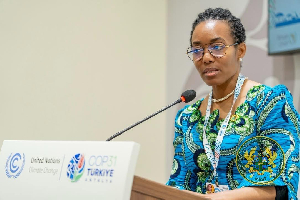
 A photo of Zanetor Agyeman-Rawlings at COP31
Africa must stop being treated as a continent seeking assistance and instead demand that developed countries honour their climate financing commitments, Dr Zanetor Agyeman-Rawlings has said.
The Minister made the call at the Africa Day Ministerial Segment of the 31st United Nations Climate Change Conference (COP31) in Antalya, Türkiye, on Sunday, November 15, 2026, urging African countries to unite in demanding climate justice, equitable access to climate finance and fair trade arrangements for the continent's critical minerals.
“Africa is not here to beg; it is here to demand that commitments be honoured,” she declared, stressing that the continent must speak with one voice in negotiations over climate change and its economic future.
Dr Agyeman-Rawlings outlined several priorities she believes must guide Africa's climate agenda, including a call to triple adaptation finance by 2035, restore degraded ecosystems and ensure that every African has access to early warning systems to help prepare for climate-related disasters.
She also placed water security at the centre of Africa's climate resilience agenda, describing access to reliable water resources as fundamental to the continent's survival and long-term development.
According to her, Africa's transition to cleaner energy and more sustainable economies must be fair and must not leave communities that depend on traditional energy and natural resources economically disadvantaged.
The Minister further called for a reassessment of how Africa's critical minerals are traded on the international market, arguing that the continent must secure fairer terms from the growing global demand for resources needed to power the clean energy transition.
Her position reflects a broader concern among African governments that the continent risks supplying the raw materials needed for the world's green industrial revolution without receiving a fair share of the resulting economic benefits.
“The world needs Africa's minerals to secure its future. Africa needs the world to honour its commitments to the continent,” she said.
Her remarks reinforce Africa's longstanding demand for climate financing that reflects the continent's vulnerability to climate change, despite its relatively small contribution to global greenhouse gas emissions.
The call also places the issue of climate justice alongside trade, industrial development and resource ownership, with African countries seeking to ensure that the global transition to a low-carbon economy delivers tangible benefits for their populations. Background and context for publication The following facts provide useful context for readers and can strengthen the story without turning it into a lengthy climate policy report.
1. COP31 and its significance: COP31 is being held in Antalya, Türkiye, from November 9 to 20, 2026. It is the 31st Conference of the Parties to the United Nations Framework Convention on Climate Change (UNFCCC), where governments negotiate international responses to climate change, including emissions reduction, adaptation and climate financing. UNFCCC+1
2. Africa's climate financing concerns: African countries have consistently called for more accessible and affordable climate finance, particularly funding for adaptation. This is important because many communities face worsening droughts, floods, coastal erosion and other climate-related threats, while having limited resources to respond.
3. Why water security matters: Water supports agriculture, electricity generation, sanitation, public health and livelihoods. The African Union and African Development Bank placed water security at the centre of Africa Day at COP31, under the theme Securing Africa's Water: Unlocking the Continent's Climate Resilience Goals. African Development Bank+1
4. Early warning systems: These systems use weather forecasts, monitoring and risk communication to alert communities ahead of floods, droughts and other hazards. Their effectiveness depends not only on forecasting technology but also on ensuring warnings reach vulnerable communities in time for them to act.
5. Critical minerals and the energy transition: Minerals such as lithium, cobalt, manganese, graphite and copper are important to batteries, electric vehicles, electricity networks and renewable energy technologies. Africa's argument is that mineral-producing countries should gain more than revenue from exporting raw materials. They also want investment in local processing, manufacturing, technology transfer and jobs.
6. The just transition: This refers to moving towards cleaner energy and environmentally sustainable economic activities while protecting workers, households and communities that could lose livelihoods during the transition. For African countries, the debate also involves access to affordable energy, industrialisation and the right to develop.
A particularly relevant development at COP31 is the African Day programme's emphasis on financing water and sanitation, strengthening multi-hazard early warning systems, restoring ecosystems and securing investment for climate resilience.
EA

Copyright © 1994 - 2026 GhanaWeb. All rights reserved.










