


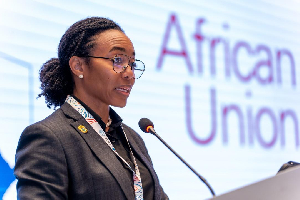
 Dr Zanetor Agyeman-Rawlings, Minister of Environment, Science, Technology and Innovation
The Minister for Environment, Science, Technology and Innovation, Dr Zanetor Agyeman-Rawlings, has called for increased and predictable climate financing for Africa, saying the continent needs about $305 billion annually by 2035 to address its climate adaptation needs.
She said Africa’s climate financing requirements far exceeded the available resources, despite the continent contributing only about four percent of global emissions.
Dr Zanetor made the call at the African Ministerial Conference on the Environment meeting on the sidelines of the 31st Conference of the Parties (COP31) in Antalya, Türkiye.
She noted that Africa loses an estimated 2-5 per cent of its gross domestic product annually to climate extremes, describing the situation as an injustice that should shape discussions at the global climate conference.
“Africa's case rests on one point: commitments already made must now be funded, tracked and delivered on fair terms,” she said.
Dr Zanetor called for the implementation of the commitment made at COP30 in Belém to at least triple adaptation finance for developing countries by 2035.
She said Africa expects the commitment to translate into approximately $120 billion annually by 2035, while stressing that the continent's actual adaptation needs are significantly higher.
She further noted that international public adaptation finance stood at only $28-32 billion in 2024, highlighting the funding gap facing African countries.
The Minister also urged developed countries to deliver on the $1.3 trillion annual climate finance roadmap under the Baku-to-Belém process, insisting that the $300 billion annual target agreed in Baku should be treated as a minimum rather than a ceiling.
According to her, Africa requires about $277 billion annually up to 2030 to implement its Nationally Determined Contributions, but current climate finance flows cover only about 11 per cent of that requirement.
She called for climate finance to be predictable, grant-based or highly concessional, warning against funding arrangements that could deepen the debt burden of developing countries.
Dr Zanetor also called for a credible replenishment of the Green Climate Fund and increased contributions to the Fund for Responding to Loss and Damage.
She said the loss and damage fund had approximately $250 million available for its first funding round, against requests estimated at between $2 billion and $3 billion, including $1.4 billion from African countries.
On the transition to cleaner energy, she urged global partners to support a country-led and grant-based Just Transition Mechanism that prioritises reliable electricity, skills development and local processing of critical minerals.
She noted that Africa holds about 30 per cent of the world's critical mineral reserves but continues to export much of its resources without processing them locally.
Dr Zanetor called for greater investment in regional value chains for batteries, clean energy equipment and green industries, using the African Continental Free Trade Area (AfCFTA) to promote industrialisation and create jobs.
She also warned that unilateral climate-related trade measures could restrict African exports and undermine the continent's industrial development.
“Climate-related trade measures elsewhere must not undercut” Africa's efforts to use the AfCFTA as a platform for green industrialisation, she said.
On carbon markets, the Minister said Article 6 of the Paris Agreement must generate genuine investment, guarantee fair prices and ensure that host countries and local communities benefit from carbon trading arrangements.
She highlighted Ghana's experience, noting that the country was the first in Africa to complete the authorisation, issuance, transfer and reporting of Internationally Transferred Mitigation Outcomes.
Under an agreement with Switzerland, Ghana has transferred 34,705 Internationally Transferred Mitigation Outcomes from a rural cookstove project.
She said Ghana was prepared to share its experience with other African countries through peer-learning programmes on carbon market readiness, including the establishment of registries, authorisation and corresponding adjustments.
Dr Zanetor urged African environment ministers to maintain a united position at COP31 and resist any attempt to weaken existing climate commitments.
“No backsliding on the Belém commitment to triple adaptation finance. No new obligations on Africa without the means of implementation to meet them,” she stated.
She further called for climate finance to be properly accounted for and cautioned against double counting or the delivery of funding mainly through loans.
With COP32 scheduled to take place in Addis Ababa, Ethiopia, in 2027, Dr Zanetor said the outcomes of the Antalya conference should establish a strong foundation for Africa's climate priorities.
“Africa has done its part. We come with credible Nationally Determined Contributions, working carbon markets and clear plans. What we lack is the means to implement them,” she said.
Story by Mawuli Ahorlumegah reporting from the United Nations Climate Change Conference COP31, Antalya, Türkiye

Copyright © 1994 - 2026 GhanaWeb. All rights reserved.










