


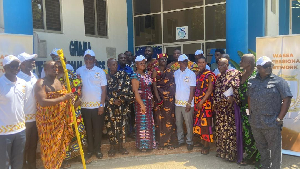
 Some of the stakeholders at the event
The Wassa Professionals Network (WPN) has called on the government to guarantee host communities a 10 percent equity stake and a direct 2 percent share of gross mineral sales revenue in all mining lease renewals within the Wassa traditional area.
The Network says the proposal, which forms part of what it describes as the “Wassa Reset,” is intended to ensure that communities whose ancestral lands host mineral resources benefit directly from the wealth generated through mining activities.
The demand was contained in a press statement presented in Accra on November 17, 2026, during a press conference attended by the Omanhene of the Wassa Fiase Traditional Area, Benso, Odeneho Akrofa Krukoko III, his elders and other traditional leaders from the Wassa traditional area.
The Chief Executive Officer of the Petroleum Hub Development Corporation (PHDC), Dr Toni Aubynn, also threw his weight behind the call, advocating a 10 percent community share in mining operations to ensure that host communities have a direct stake in the resources extracted from their lands.
The WPN identified the ongoing renewal of Gold Fields Ghana Limited's Tarkwa Mine lease as a historic opportunity for the country to reconsider the ownership, governance and distribution of benefits from its mineral resources.
The Network led by President of the Wassa Professionals Network, Justice Joshua Conbinah, is proposing a 10 percent free-carried equity interest for host communities, to be managed through an accountable Wassa Trust Fund, with voting rights and representation on the boards of mining companies.
The network also demands a direct allocation of 2 percent of gross mineral sales revenue, payable quarterly into the proposed Trust Fund, without deductions for operational costs, debts or management fees.
Benjamin Danso unseats NDC’s Greater Accra Regional Chairman Ashie Moore
Additionally, the group wants "formal representation of Wassa communities, including through the WPN, in mining lease transition arrangements, negotiations and governance structures of future mining operations within the Wassa enclave."
According to the Network, the proposed benefits should complement, rather than replace, statutory royalties, taxes, lawful compensation, environmental restoration obligations and existing community development commitments.
The WPN argued that although mining operations have contributed significantly to Ghana's foreign exchange earnings, public revenue, employment and industrial development, host communities continue to bear substantial social, economic, cultural and environmental costs without a guaranteed direct ownership stake in the wealth generated from their lands.
They cited historical research estimating that approximately 4,935 hectares of farmland were lost between 1986 and 2002 within the Tarkwa, Bogoso/Prestea and Damang mining concessions, representing about 45 percent of the farmland in the areas studied.
The group also highlighted mining-related displacement, environmental degradation, the loss of cultural heritage sites and the long-term impact of mining activities on agricultural livelihoods as some of the sacrifices made by communities.
On the economic significance of the Tarkwa Mine, the WPN referenced Gold Fields' November 2025 Mineral Resources and Mineral Reserves declaration, which indicated that managed mineral reserves increased from 4.3 million ounces in 2024 to 7.4 million ounces.
The figures, according to the statement, suggest an estimated mine life of approximately 17 years, with further potential from additional mineral resources, underground development and exploration.
The Network also acknowledged Gold Fields Ghana Limited's contribution to the national economy and host communities, noting that the company reported approximately GH¢5.8 billion in corporate taxes, royalties and dividends to Government in 2025, alongside GH¢8.8 billion in local procurement.
However, it maintained that employment opportunities, local procurement, compensation and corporate social responsibility initiatives, although valuable, do not constitute sufficient indigenous community participation in the ownership and governance of mining operations.
The WPN further called for a review of the conventional mining ownership structure, under which investors hold 90 percent equity while the government retains a 10 percent free-carried interest.
“We are not asking for charity. We are calling for equity, ownership, justice and intergenerational prosperity."
As part of its proposed alternative, the group is advocating an ownership arrangement comprising 60 percent for mining investors, 10 percent for the government, 10 percent for host communities through the Wassa Trust Fund and 20 percent to be floated on the Ghana Stock Exchange.
It believes the proposed model would preserve majority investor ownership while expanding community participation and creating opportunities for broader Ghanaian investment through the domestic capital market.
The Network cited mining governance arrangements in countries including the Democratic Republic of Congo, Botswana, Guinea, Tanzania, Papua New Guinea, South Africa, Canada and Australia as examples of efforts to increase local ownership and participation in mineral development.
It stressed, however, that the proposed arrangements would require appropriate legal, regulatory and commercial consideration.
The WPN's position comes amid growing national attention surrounding the renewal of Gold Fields Ghana Limited's Tarkwa Mine lease, following the company's renewal application in November 2025 and the submission of a comprehensive proposal to Government in July 2026.
AM
Samira Bawumia Stuns Audience with ‘Asaase Yaa’ Poem at Literary Night

Copyright © 1994 - 2026 GhanaWeb. All rights reserved.










