


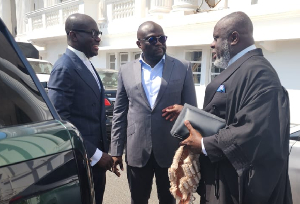
 Godfred Dame with Abdul-Wahab Hanan and Lawyer Kojo Frempong after Court proceedings
The criminal trial of Hanan Abdul-Wahab Aludiba, former Chief Executive Officer of the National Food and Buffer Stock Company and his wife, Faiza Seidu Wuni, has suffered another setback after the Court of Appeal adjourned proceedings sine die following a ruling that went in favour of Godfred Yeboah Dame, lead counsel for the first accused person, Hanan Abdul-Wahab Aludiba.
The adjournment followed an Application for Rectification of the Record of Appeal filed by the 1st Accused/Appellant, Hanan Abdul-Wahab Aludiba, through his lead counsel, the former Attorney-General. The application, together with the substantive appeal, had been listed for hearing on Wednesday, 18th November, 2026.
2nd Accused claims non-service; court records show otherwise
During proceedings, the 2nd Accused, Faiza Seidu Wuni, claimed in open court that the application had not been served on either her or her counsel, Augustines Obour.
Court records, however, indicated that the application was served on counsel for the 2nd Accused through his clerk, although just the day before the hearing.
Counsel for the 1st Accused, Godfred Dame, argued that per the Rules of Court, counsel for the 2nd Accused must be afforded the right to be heard.
Dame emphasized the requirement of a three-day window between service and the scheduled hearing, pointing out that the record showed service was effected less than 24 hours before the hearing.
Godfred Yeboah Dame stated that in any event, he also intended to exercise his right to file a response to the affidavit in opposition filed by the Office of the Attorney-General.
The Deputy Attorney-General, Dr Justice Srem-Sai, representing the Republic, argued that counsel for the 2nd Accused should have appeared and argued short service. He further argued that counsel for the 2nd Accused had, from the outset, demonstrated disinterest in the matter.
By Court
The Court held that counsel for the 2nd Accused had been duly served and ought to have been present to argue that he had been short-served.
The Court granted counsel for the 1st Accused seven days to file a Reply to the Affidavit in Opposition filed by the Republic.
It further ruled that if counsel for the 2nd Accused has anything to file, he may do so within the period. The Application for Rectification of the Record was adjourned sine die.
Godfred Yeboah Dame further submitted that in light of the adjournment of the Application for Rectification upon which the substantive appeal rests, the Court of Appeal would have to adjourn the substantive appeal sine die. This request was also granted by the Court.
Earlier ruling: Stay of Proceedings granted
The adjournment follows an earlier ruling in which the Court of Appeal granted the 1st Accused's Motion on Notice for an Order Staying Proceedings of the High Court pending appeal.
Moving the application, Dame had argued that the issues raised in the appeal are fundamental to the Applicant's human rights and that there would be a substantial miscarriage of justice if the prayer was not granted.
He exhibited the charge sheet (Exhibit HCA1) and pointed to what he described as material defects in the charges, including the lumping together of distinct transactions in the stealing counts over a broad time frame from 2017 to 2025.
Dame further submitted that the prosecution's facts referred to 86 undated transactions with missing details, and that the prosecution did not state how the stealing occurred. He relied on Section 109 of Act 30, which requires that a specific act be identified as the specific act of the offence charged.
On the charge of defrauding by false pretense, Dame argued that the false pretense was not disclosed and must be specified, citing Osei Kwadwo v Republic. On causing financial loss, he submitted that no particulars were given and relied on Republic v Ernest Thompson, arguing that a charge sheet lacking details is bad in law and that a trial cannot be sustained on it.
Dame emphasized that the defects were not matters of form but went to the court's jurisdiction, citing Akwasi Osei Adjei v. The Republic.
He noted that the record of appeal was ready and not voluminous, and that the Republic had nothing to lose, while it was in the interest of justice to ensure all defects were cured before facing what he described as the recent situation in Ationu v The Republic.
Respondent's opposition
The Deputy Attorney-General, Dr Justice Srem-Sai, opposed the application, arguing that authorities are clear on the grant of stay of proceedings and that the application must disclose exceptional circumstances.
He submitted that embellishment cannot create exceptional circumstances and that reasonable information is what is required, adding that the accused was told in a language he understands.
Dr Srem-Sai further argued that the trial judge and the other accused person understood the charges, and that criminal jurisprudence does not require repeated acts over a period to be separated, relying on Section 112 of Act 30 (1), (2), (4) and Article 19(2)(d).
He submitted that the Applicant's disagreement with the trial judge's ruling was not sufficient grounds to stay proceedings and prayed that the application be refused.
Obour's intervention
Augustine Obour, counsel for the 2nd Accused, informed the Court that he is counsel for the other accused person and craved the Court's leave to be heard. The Respondent objected, noting that Obour had filed nothing and therefore ought not to be heard.
The Court, however, briefly heard Obour, who associated himself with the Applicant's submissions on points of law.
Court's reasoning
In its ruling delivered by Justice Jerome Noble Nkrumah, the Court held that a charge sheet, being the fundamental document to a criminal trial, carries the superstructure of the trial, conviction or otherwise and sentence.
A challenge therefore to the content of a charge sheet ought to be dealt with as early as practicable, else the risk of the collapse of the action built on it.
The Court found the matter raised by the Applicant exceptional enough to warrant granting the application, holding that when questions are raised as to the validity or legal correctness, including the drafting soundness, of a charge sheet, those issues cannot be glossed over. It serves no purpose to proceed with an action when such an appeal is pending, the Court concluded.
Background to the case
The substantive case for trial is The Republic v Hanan Abdul-Wahab Aludiba & Faiza Seidu Wuni. The appeal before the Court of Appeal is against the trial High Court's ruling on an objection raised by the 1st Accused Person regarding the propriety of the charges on the Charge Sheet.
The 1st Accused/Appellant, having filed a Notice of Appeal, applied for a Stay of Proceedings, which the Court of Appeal granted. The substantive appeal was subsequently listed for hearing, but the 1st Accused/Appellant filed an Application for Rectification of the Record of Appeal.
With the application for rectification now adjourned sine die and the substantive appeal following suit, the trial of Hanan Abdul-Wahab Aludiba and Faiza Seidu Wuni remains on hold, with the Court of Appeal having found merit in the preliminary objections raised by the 1st Accused.
Godfred Nsiah Speaks on the Growth and Future of Jiu-Jitsu in Ashanti Region

Copyright © 1994 - 2026 GhanaWeb. All rights reserved.










