


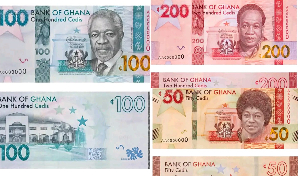
 File photo of the new heritage series note
The Bank of Ghana (BoG) is drafting a new Currency Act to replace the 62-year-old law that governs the cedi, with tougher penalties for counterfeiters. The move comes as the central bank prepares to put a new family of banknotes into circulation from December 1.
The Governor of the BoG, Dr Johnson Pandit Asiama, announced the plan at the launch of the Ghana Cedi Heritage Series at Bank Square in Accra on Thursday, with a stern warning to those who fake the currency.
“Let me say that counterfeiting will soon become a very painful experience,” he said.
The Governor said the Currency Act, 1964 (Act 242), had governed the cedi for many decades but “was enacted in a very different era”. The new law will strengthen provisions against counterfeiting “with penalties proportionate to the seriousness of the offence”. It will also set out clear procedures for detecting, surrendering, authenticating and destroying fake notes, and give firmer legal backing to the fight against the mutilation and abuse of notes and coins.
“In this way, the security built into the Heritage Series will be matched by laws that protect the currency and those who use it,” he said.
Under the current law as amended, offenders are liable upon summary conviction to imprisonment not exceeding 10 years, or a fine not exceeding 2,000 penalty units, or both.
The new law and the new notes are part of a wider push to protect a currency the Governor described as far more than money.
“The national currency is more than a means of payment. It represents a country’s capacity to manage its monetary affairs through its own institutions,” Dr Asiama said. “Its credibility depends on sound policies, effective institutions, and the confidence of those who use it.”
The BoG says the change was overdue. The core designs of the existing banknotes have been in circulation for more than two decades. In August, President John Dramani Mahama, who launched the new series on Thursday last week, described the present notes as “long overdue for refreshing.”
President Mahama said the new notes must be backed by a stronger economy. “The strength of our currency must be felt in the everyday lives of our people,” he said. “For the trader, it should mean greater certainty when ordering their next consignment of supplies.”
The Heritage Series answers that call with enhanced security features that the Governor said would “strengthen protection against counterfeiting and help the public identify genuine banknotes more easily”.
The notes are made from reinforced cotton paper and designed to last longer than the existing notes. Dr Asiama said their improved durability would help them “withstand Ghana’s climatic conditions and frequent handling, thereby extending their lifespan in circulation”.
They are also smaller and more portable than the current notes. “These changes demonstrate that the physical currency must continue to adapt to how people live, work and conduct business,” the Governor said.
The new notes maintain different sizes for different denominations, with enhanced tactile marks to help the visually impaired distinguish them. The BoG has also launched a Cedi App to help the public learn the new features.
The most striking change is on the face of the notes. The Big Six group portrait has appeared on every note since 2007; all the notes carry one portrait at the front of six distinguished Ghanaians who spearheaded the struggle for independence. It has now been replaced by eight individual Ghanaians, each representing a chapter of the national story, from commerce to sovereignty. Only Dr Kwame Nkrumah remains from the Big Six, and three of the eight are women.
“Each denomination tells a distinct story through its featured personalities, landmarks, and symbols, creating a series that is both functional and distinctly Ghanaian,” Dr Asiama said.
President Mahama said “these notes will also help bring our history closer to our children,” adding that “history belongs to our classrooms and museums, and it also deserves a place in our everyday lives.”
He reminded the audience that the name “cedi” comes from the Akan word for the cowrie shell, which Ghana’s forebears used to trade salt, cloth and kola from the markets of Salaga to the coast. “From the cowrie to the cedi, the story of our currency reflects the journey of our people,” he said.
The GH¢1 note, themed on commerce, carries Agnes Oforiwa Tagoe-Quarcoopome, the Makola trader who supported the independence struggle. She became the first Makola woman to open an account with the then Standard Bank of West Africa, at a time when rich Makola women customarily saved their earnings at home in safes. The reverse shows a scene from Makola Market and the Adinkra symbol Bese Saka, a sack of kola nuts signifying prosperity through commerce.
The GH¢2 note, on faith, features the late Catholic Cardinal Peter Poreku Dery, with the Larabanga Mosque on the reverse. The BoG says the pairing reflects the harmony among the country’s religions.
The GH¢5 note, on education, honors Dr James Emmanuel Kwegyir Aggrey, the educationist associated with the founding of Achimota School, which appears on the back. The BoG said it chose the school deliberately as a mixed institution with primary and secondary sections.
The GH¢10 note, on justice and equity, features Justice Annie Ruth Jiagge, the pioneering lawyer and women’s rights activist. She served as President of the Court of Appeal from 1980 to 1983. The Supreme Court and the Adinkra symbol Epa, signifying justice, appear on the reverse
The GH¢20 note, on arts and culture, celebrates Dr Ephraim Amu, the composer and musicologist, with the National Theatre and the Adinkra symbol Dono on the back.
The GH¢50 note, on nationalism, carries Theodosia Salome Okoh, the teacher and artist known for designing Ghana’s national flag in 1957. Jubilee House, the seat of the presidency, is on the reverse.
The GH¢100 note, on peace, features Kofi Annan, the former United Nations Secretary-General and Nobel Peace laureate, with the Kofi Annan International Peacekeeping Training Centre on the back.
The GH¢200 note, on sovereignty, carries Dr Kwame Nkrumah, Ghana’s first President, with the Kwame Nkrumah Mausoleum on the reverse.
“Banknotes can serve as reminders of the people, places and values that have shaped our national journey,” the Governor said. “The Heritage Series demonstrates that modernization and national identity can advance together.”
Behind the scenes, the BoG has built an Enterprise Currency Operations Management Software (ECOMS) entirely in-house. It links the central bank with commercial banks in managing currency operations. The bank will also open new cash centres at its Ho and Tamale regional offices.
The President commended the central bank for the system, saying it showed “the capability of our professionals and the value of building institutional knowledge right here at home”.
The Heritage Series covers all eight denominations, from GH¢1 to GH¢200, with no new denomination added. The notes enter circulation from December 1 and will circulate alongside the existing series, which remains legal tender.
“This approach will allow the public and businesses to adjust smoothly to the Heritage banknotes without unnecessary disruption to economic activity,” Dr Asiama said.
A nationwide education campaign will run in all regions and in major local languages “to ensure that every Ghanaian knows their cedi”. The Governor urged the public to stop all forms of currency abuse, including the deliberate mutilation and defacement of notes and coins.
“Our currency is a national asset and a symbol of our sovereignty; it must be treated with the respect it deserves,” he said.
The launch comes as the BoG approaches its 70th anniversary on March 4, 2027. The Governor did not give a timeline for when the new Currency Bill would be laid before Parliament.
“Let us carry the cedi with pride and uphold the confidence on which it rests, so that it continues to serve Ghana securely and well for generations to come,” President Mahama said.

Copyright © 1994 - 2026 GhanaWeb. All rights reserved.










