


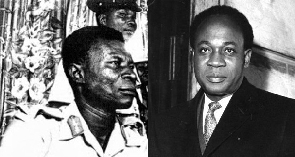
 Lt. Gen. Emmanuel Kwesi Kotoka and Osagyefo Dr. Kwame Nkrumah
Feature article by: Nathaniel Tei Atsekpe
Ghana's history is filled with remarkable moments of courage, sacrifice, political achievements and national pride. However, there are also chapters that continue to provoke difficult questions about the country's democratic journey, leadership and political stability.
One such moment is February 24, 1966, a date that remains one of the most significant turning points in Ghana's post-independence history.
It was on this day that Ghana's first President, Osagyefo Dr Kwame Nkrumah, was overthrown in a military coup organised by members of the Ghana Armed Forces and the Police Service, bringing an abrupt end to the First Republic.
More than six decades later, the events of that day remain worthy of reflection, not simply because a government was removed from power, but because of the far-reaching consequences the coup had on Ghana's political, economic and democratic development.
The events of February 24, 1966
On February 24, 1966, while President Nkrumah was outside the country on a diplomatic mission to Asia, military and police officers moved to seize control of the government.
Nkrumah was travelling to Beijing, China, when the coup took place. The operation was led by senior military and police officers who had become increasingly dissatisfied with his administration.
Among the prominent figures associated with the coup were Major General Emmanuel Kwasi Kotoka, Lieutenant General Joseph Arthur Ankrah, Colonel Akwasi Amankwa Afrifa and Police Commissioner John Willie Kofi Harlley.
The coup plotters announced that they had taken over the government, effectively ending Nkrumah's presidency.
In the aftermath, the Convention People's Party (CPP) government was dissolved, Parliament was dismissed and the 1960 Constitution was suspended.
The coup leaders subsequently established the National Liberation Council (NLC), with Lieutenant General J.A. Ankrah as its chairman.
The takeover was a defining moment in the country's political history, marking the first successful military coup since Ghana gained independence in 1957.
What led to Nkrumah's overthrow?
Although the coup took many Ghanaians by surprise, it followed years of growing political tensions, economic difficulties and dissatisfaction within sections of the military and the wider population.
Nkrumah's government had pursued an ambitious development agenda centred on industrialisation, infrastructure, education, Pan-Africanism and economic independence.
His administration oversaw major national projects, including the Akosombo Dam, Tema Harbour and the Tema Motorway. These projects reflected his ambition to transform Ghana into an industrialised nation and establish the country as a leading force on the African continent.
However, his administration also faced criticism over its increasingly authoritarian approach to governance.
The introduction of the one-party state, restrictions on political opposition, the use of the Preventive Detention Act and concerns about human rights contributed to growing opposition to his government.
Economic challenges, including declining cocoa revenues, mounting foreign debt and unemployment, further complicated the situation.
The military also had grievances, with dissatisfaction among sections of the security services becoming an important factor in the events that eventually led to the coup.
The coup leaders justified their actions by citing what they described as authoritarian rule, economic mismanagement and restrictions on individual freedoms.
However, whether these challenges justified the overthrow of a constitutionally established government remains a subject of historical and political debate.
The controversy surrounding foreign involvement
One of the most debated aspects of the February 24 coup is the alleged involvement of foreign powers, particularly the United States.
Nkrumah's strong anti-imperialist position, his relationship with socialist countries and his advocacy for African political and economic independence had created tensions between his government and Western powers.
Declassified American diplomatic records show that US officials were aware of plots against Nkrumah before the coup.
However, the United States government's historical account of the events states that although American officials knew about the coup plots, the records indicated that Washington was not otherwise involved in organising them.
This has not ended the debate over foreign influence in the overthrow. Researchers and commentators continue to examine the geopolitical interests surrounding the coup and the role played by external actors.
What remains clear is that February 24, 1966, was not merely a domestic political event. It unfolded during the Cold War, when competing global interests were influencing political developments across Africa.
The consequences Ghana could not escape
The overthrow of Nkrumah marked the beginning of a new political chapter for Ghana.
The National Liberation Council took control of the country and remained in power until 1969, when the country returned to civilian constitutional rule.
The Progress Party, led by Dr Kofi Abrefa Busia, won the 1969 general election, paving the way for the establishment of the Second Republic.
However, Ghana's return to civilian government did not end the country's political instability.
On January 13, 1972, Colonel Ignatius Kutu Acheampong overthrew the Busia government in another military coup.
Subsequent military interventions in 1979 and 1981 further demonstrated the difficulties Ghana faced in maintaining uninterrupted constitutional governance.
Although these later coups had their own immediate causes, the 1966 overthrow became an important starting point in the history of military interventions that interrupted Ghana's democratic development.
The country would eventually return to constitutional democratic rule on January 7, 1993, under the Fourth Republic, which has since provided a framework for successive elected governments.
Why February 24 must never be forgotten
February 24, 1966, matters beyond the removal of one president.
It raises fundamental questions about the limits of political power, the importance of constitutional governance and the responsibility of state institutions to protect democratic principles.
In February 2025, Parliament marked the 59th anniversary of Nkrumah's overthrow with a commemorative statement and contributions from several Members of Parliament.
North Tongu MP Samuel Okudzeto Ablakwa described the date as a shameful day in Ghana's history, while other MPs emphasised the need to learn from past mistakes and protect the country's constitutional democracy.
The parliamentary discussions also highlighted an important point: while governments and political leaders may make mistakes, military intervention should not be treated as an acceptable alternative to democratic accountability.
Ghana's current democratic dispensation, established under the 1992 Constitution, is a reminder of the importance of protecting the institutions that guarantee political participation, freedom of expression and the peaceful transfer of power.
The events of 1966 should therefore serve as a lesson to political leaders, security institutions and citizens alike.
Governments must remain accountable to the people, opposition voices must be respected, and state institutions must operate within the confines of the Constitution.
At the same time, citizens must recognise that democracy requires active participation, vigilance and a collective commitment to national development.
A lesson for present and future generations
As Ghana continues to pursue economic transformation and democratic consolidation, the lessons of February 24, 1966, remain relevant.
The country cannot afford to overlook the events that shaped its political history or allow partisan interests to prevent an honest examination of the past.
Nkrumah's achievements, his shortcomings, the circumstances surrounding his overthrow and the consequences that followed must all be examined objectively.
Remembering February 24 is not necessarily about endorsing every decision taken by Nkrumah or ignoring the challenges his government faced. Rather, it is about recognising that the removal of a government through military force carries consequences that can extend across generations.
Ghana has made significant progress since those turbulent years. The peaceful transfer of power under the Fourth Republic is an achievement that must be protected and strengthened.
February 24, 1966, must remain a reminder that political power is temporary, but the institutions and democratic principles that hold a nation together must endure.
It is a day Ghana must never forget.

Copyright © 1994 - 2026 GhanaWeb. All rights reserved.










