


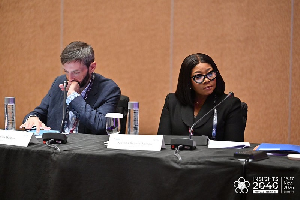
 Deputy Governor with Singapore's Minister for Foreign Affairs and National Development
The Bank of Ghana has strengthened its engagement in global financial policy discussions through its participation in the Insights2040 Annual Meetings and the Singapore fintech Festival (SFF) 2026, two major international platforms examining the future of financial services, cross-border payments and emerging technologies.
The Festival featured over 600 sponsors and exhibitors and more than 40 international pavilions showcasing developments in digital financial services, artificial intelligence, digital assets and emerging financial infrastructure.
The Bank's delegation, led by the Second Deputy Governor, Mrs. Matilda Asante-Asiedu, participated in high-level engagements bringing together central bank officials, financial regulators, policymakers, financial institutions and technology innovators to exchange perspectives on developments shaping the global financial ecosystem.
The Insights2040 Annual Meetings, held from 16 to 17 November 2026, attracted about 5,000 participants, while the Singapore fintech Festival, held from 18 to 20 November 2026, was projected to welcome more than 70,000 participants from across the world.
Together, the engagements provided opportunities for international collaboration, knowledge exchange and discussions on financial connectivity, artificial intelligence (AI), digital money, tokenisation, financial inclusion and regulatory cooperation.
Strengthening Cross-Border Payments to Connect African Economies
Delivering opening remarks at the Insights2040 Annual Meetings, the Second Deputy Governor emphasised the need to move beyond simply connecting payment systems to achieving meaningful economic integration.
She underscored the importance of moving beyond global averages to monitor progress within individual payment corridors across Africa, advocating a more targeted and evidence-based approach to assessing cross-border payment performance.
According to Asante-Asiedu, measuring transaction costs, transparency, reliability and access to funds across specific payment corridors would enable regulators, financial institutions and payment service providers to identify successful interventions, address existing gaps and improve payment efficiency.
Her remarks highlighted the importance of ensuring that advances in payment infrastructure translate into tangible benefits for businesses and households through more affordable, reliable, transparent and accessible cross-border transactions.
The intervention brought an African perspective to global discussions on payment connectivity, particularly the need to strengthen financial infrastructure to facilitate trade, remittances, investment and regional economic integration.
Strengthening Bilateral Cooperation Between Ghana and Singapore
As part of her engagements in Singapore, the Second Deputy Governor also met with Singapore's Minister of State for Foreign Affairs and National Development, Alvin Tan, to discuss opportunities for strengthening bilateral cooperation between Ghana and Singapore.
The engagement highlighted shared priorities in financial innovation, digital payments, cross-border transactions and the adoption of artificial intelligence, reflecting the growing importance of technological advancement in strengthening financial connectivity and economic cooperation.
The discussions also acknowledged the ongoing collaboration between the Bank of Ghana and the Monetary Authority of Singapore (MAS), which provides a foundation for advancing these shared priorities.
The engagement further highlighted plans to welcome a Singaporean delegation to Ghana in January 2027 for continued discussions aimed at deepening bilateral relations and exploring new opportunities for cooperation.
The Director of the Bank's fintech and Innovation Department, Mr. Owureku Asare, contributed to discussions on emerging financial technologies and evolving regulatory frameworks at a roundtable titled Tokenized Markets: Frictions, Choices and the Path to Interoperability.
The discussion explored the opportunities and challenges associated with the growth of tokenised financial markets, with particular emphasis on addressing fragmented infrastructure, navigating regulatory differences and strengthening interoperability between emerging digital asset platforms and existing financial systems to support a more integrated, efficient and resilient financial ecosystem.
Exploring Stablecoins as Global Payments Infrastructure
Philip Kwaw Sebuabe, Head of Virtual Assets at the Bank of Ghana, also participated in a roundtable discussion titled Beyond Disruption as Global Payments Infrastructure at the Insights2040 Annual Meetings. Stablecoins, which are digital assets designed to maintain a relatively stable value by reference to an underlying asset or currency, are increasingly attracting global attention as potential instruments for payment and settlement.
The discussions explored opportunities associated with their use, including reduced transaction frictions, improved settlement efficiency and more seamless movement of funds across jurisdictions.
Sebuabe's participation reflected the Bank of Ghana's continued engagement in international discussions on virtual assets and the evolving regulatory frameworks needed to support responsible innovation in digital financial services.
Singapore fintech Festival 2026: Rewiring the Global Financial System
The Singapore fintech Festival 2026, held from 18 to 20 November at the Singapore EXPO, was organised under the theme The Coming Rewiring of the Financial System: New Risks. New Rules. New Growth.
Organised by the Monetary Authority of Singapore and the Global Finance & Technology Network, in collaboration with the Association of Banks in Singapore, the Festival marked its 11th edition as one of the world's major platforms for financial technology innovation and policy dialogue.
This year's theme explored how five interconnected forces, technology, geoeconomics, capital, talent and policy, are reshaping the architecture of global finance.
The discussions examined the implications of rapid technological advancement, changing international economic relationships, evolving capital flows, workforce transformation and emerging regulatory priorities.
A central focus was how financial institutions, policymakers and regulators could harness technological innovation to support economic growth and financial inclusion while addressing emerging risks and safeguarding financial stability.
Artificial Intelligence Takes Centre Stage in the Future of Finance
Artificial intelligence emerged as a major focus of this year's Festival, with discussions examining its growing influence on financial services, payment systems, risk management, productivity and regulatory oversight.
Of particular significance was the emergence of agentic AI, a new generation of AI systems capable of executing tasks, making certain decisions and initiating actions with varying degrees of autonomy.
Unlike conventional AI applications that primarily analyse information or respond to instructions, agentic AI systems can undertake multi-step processes, potentially transforming how financial institutions deliver services and how consumers and businesses conduct financial transactions.
These developments present opportunities to improve operational efficiency, automate financial processes, strengthen risk assessment, enhance customer experiences and facilitate more seamless payment services.
However, the increasing use of AI in financial services also introduces regulatory considerations relating to accountability, cybersecurity, data protection, consumer safeguards, operational resilience and the reliability of autonomous financial systems.
For central banks and financial regulators, the discussions underscored the importance of developing appropriate governance and supervisory approaches that enable innovation while preserving confidence and stability in the financial system.
AI, Economic Growth and the Future of Employment
The Festival also explored the broader economic implications of artificial intelligence, particularly its impact on productivity, employment, skills development and competitiveness. Discussions highlighted opportunities for AI-driven innovation while emphasising the need to address potential inequalities in access to technology and its benefits, particularly in developing economies such as Ghana.
Balancing Financial Innovation with Regulatory Oversight
Discussions underscored the importance of balancing technological innovation with effective regulatory oversight. As AI, tokenisation and stablecoins transform financial services, regulators must address emerging risks relating to financial stability, cybersecurity and consumer protection while strengthening international cooperation and regulatory interoperability.
Through these engagements, the Bank of Ghana continues to strengthen its international relationships and contribute to discussions aimed at building a more connected, innovative, inclusive and resilient financial system in Ghana, across Africa and globally.

Copyright © 1994 - 2026 GhanaWeb. All rights reserved.










