


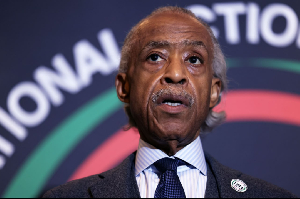
 Rev Al Sharpton is an American civil rights leader
American civil rights leader, Rev Al Sharpton, has called for greater unity between Africans and African Americans, warning that hostility towards immigrants and divisions within the Black community are undermining their shared identity and solidarity.
Delivering a speech at the funeral of 15-year-old Ghanaian, Javits Badu Nkansah Frimpong, at the New Covenant Dominion Church in the Bronx, New York, Rev Sharpton said the response to the teenager’s killing had exposed a lack of solidarity among some members of the African American community.
He observed that while members of the Ghanaian and wider African communities had rallied around the family, the turnout from African Americans had not been as strong as he expected.
Ghanaian boy killed in US 'deserved so much better' - New York Mayor
“If this had been a racial killing, we’d have been rallying. The fact that it was us on us. I saw the Ghanaian community rally. I saw many from Africa rally. I saw a few that believe in the diaspora like Queen Mother Blakely rally. But I didn’t see a lot of us that should be here today because we must be against this no matter who does it, no matter what the cause,” he said.
The founder and president of the National Action Network (NAN) insisted that violence within the Black community must be condemned regardless of the identities of those involved.
He also criticised attitudes among some African Americans towards African immigrants, particularly the tendency to regard those with different accents and places of birth as outsiders.
“Black on black hate must stop. The ignorance and arrogance that is being perpetrated against immigrants, especially among our African American community. Talking about they’re not one of us,” he said.
Rev Sharpton challenged the distinction between Africans on the continent and those in the diaspora, arguing that their different experiences did not erase their common ancestry.
“We all are African, some displaced African, some at home African. We’re all African,” he declared.
He warned that hostility towards people with different accents and backgrounds had spread to younger generations, creating an environment in which children could grow up viewing one another as outsiders.
“This poison of being against those with a different accent, with a different birthplace, has gotten down into our children,” he said.
Reflecting on Javits’ life and ambitions, Rev Sharpton said the teenager had wanted to become a doctor and serve in the military, but his aspirations had been cut short.
He likened the circumstances surrounding the killing to the biblical account of Joseph and his brothers, describing jealousy and envy towards someone perceived as different as a problem that needed to be confronted.
The civil rights leader also drew parallels between the historical experiences of Africans and African Americans, recalling the transatlantic slave trade and colonialism in Ghana.
He referenced Ghana’s first President, Dr Kwame Nkrumah, and noted that American civil rights figures Martin Luther King Jr. and Adam Clayton Powell Jr. attended his presidential inauguration.
“Don’t act like Ghanaians didn’t have to fight. Kwame Nkrumah had to fight,” he said, stressing the historical connections between the struggles of Africans and African Americans.
Rev Sharpton further urged parents to use family gatherings during the Thanksgiving holiday to teach their children tolerance, acceptance and respect for people from different backgrounds.
He said the lesson should be that differences in accents, birthplace and skin tones should never become reasons for hatred.
“We may have different accents. We may have even different hues of the rainbow. But you can’t hate your brother. You can’t hate your sister. When you hate any one of us, you tear down all of us,” he said.
In one of the most poignant moments of his eulogy, Rev Sharpton returned to Javits’ dream of becoming a doctor, saying that although the teenager would not live to fulfil that ambition, his death should inspire efforts to heal divisions within the community.
“Javits, even though you never went to medical school and became a doctor, we’re going to use you to heal a community,” he said.
He described the teenager as someone whose death had brought attention to what he called self-hatred, hostility towards immigrants and divisions among Black people.
“Javits, you’re a doctor that got our attention. You gave us a diagnosis that we’re going to go in and serve and carve out the hate in our community,” Rev. Sharpton said.
He called on parents and community leaders to teach younger generations to love and support one another, urging them to make Javits’ memory a catalyst for change.
“Let us make Javits a doctor.”
AS/VPO

Copyright © 1994 - 2026 GhanaWeb. All rights reserved.










