



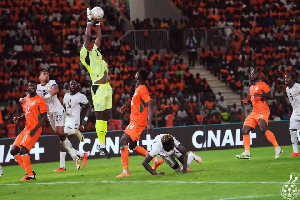
 Côte d’Ivoire were awarded a controversial against Ghana
Carlos Queiroz was visibly frustrated after Ghana’s 2-0 defeat to Côte d’Ivoire in Bouaké on Thursday, September 24, 2026, with the Black Stars coach questioning the decision to award the hosts a second-half penalty.
With Ghana trailing 1-0, referee Mustapha Ghorbal pointed to the spot after Abdul Fatawu Issahaku’s challenge on Malick Yalcouyé. Franck Kessié converted to put Côte d’Ivoire 2-0 ahead.
Queiroz later described the decision as “a joke” after seeing television replays, while several discussions following the match have also questioned whether the contact was sufficient for a penalty.
The obvious question, therefore, is: why was VAR not used?
Fatawu 4, Sibo 4, Djiku 6: Check out Black Stars’ player ratings vs Côte d’Ivoire
The answer is largely about consistency and infrastructure.
VAR requires more than simply having cameras inside a stadium.
The venue must have the necessary technical infrastructure, communications systems, qualified personnel and operational arrangements for the technology to function properly.
That creates a particular challenge for an Africa-wide qualifying competition involving 54 member associations and numerous stadiums with different levels of infrastructure.
Bouaké itself is capable of hosting VAR operations.
The Stade de la Paix was one of the venues used during the 2023 Africa Cup of Nations, a tournament in which CAF deployed VAR across all 52 matches.
But the AFCON qualifiers are played across a much wider range of venues.
CAF’s stadium regulations recognise different categories of facilities for different competitions, with the requirements for AFCON qualifiers falling below those of the final tournament.
Countries without an approved stadium can also be required to play at an approved venue outside their territory.
This is where the issue of competitive fairness comes in.
If VAR were available in Bouaké but unavailable at another qualifying venue, teams would effectively be playing under different officiating conditions depending on where their matches are staged.
That is why introducing VAR throughout the qualifiers would require CAF to ensure that the technology can be consistently operated across the competition, rather than simply activating it at selected stadiums.
For now, Ghana must live with the Bouaké decision.
The Black Stars return to action on September 29, 2026, against The Gambia in Accra.
FKA/JKB
2027 AFCONQ: Black Stars Hold First Training Session Ahead of Côte d’Ivoire Clash

Copyright © 1994 - 2026 GhanaWeb. All rights reserved.










