


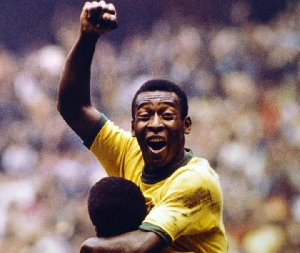
 Pelé, Edson Arantes do Nascimento
Brazilian football legend Pelé, widely regarded as one of the greatest players to ever grace the game, was born on October 23, 1940, leaving behind a legacy that continues to shape football more than six decades after his rise to global fame.
Born Edson Arantes do Nascimento, Pelé rose from humble beginnings in Brazil to become a global sporting icon, earning the nickname “The King of Football” through his extraordinary talent, goal-scoring ability and success on the international stage.
His greatest achievement came with Brazil’s national team, which he helped lead to FIFA World Cup glory in 1958, 1962 and 1970. He remains the only male player to have won three FIFA World Cup titles as a player, a record that continues to set him apart in football history.
Pelé first announced himself to the world at the 1958 World Cup in Sweden, where, at just 17, he scored six goals, including a hat-trick against France in the semi-final and two goals in Brazil’s 5-2 victory over Sweden in the final.
Although injuries limited his involvement in Brazil’s successful 1962 campaign, he returned to the World Cup stage in 1970 to help inspire one of the most celebrated teams in the tournament’s history. Brazil defeated Italy 4-1 in the final in Mexico, with Pelé scoring the opening goal.
Beyond his World Cup triumphs, Pelé became synonymous with Brazilian football, helping elevate the country’s reputation as a global football powerhouse. His performances for Santos, the Brazilian club where he spent much of his career, also attracted international attention and helped establish his status as a sporting phenomenon.
Pelé’s influence extended beyond the pitch, with his name becoming recognised across generations of football fans. His career demonstrated how sporting excellence could transcend national borders, making him an enduring symbol of Brazil’s footballing identity.
He died on December 29, 2022, aged 82, following a battle with colon cancer. However, his legacy remains firmly rooted in the history of the sport.
As the football world marks what would have been his 86th birthday on October 23, Pelé’s story serves as a reminder of an era when one player’s brilliance helped turn football into a truly global spectacle.
More than a footballer, Pelé remains a symbol of sporting greatness whose three World Cup triumphs continue to distinguish him from every other male player in the history of the competition.
EA

Copyright © 1994 - 2026 GhanaWeb. All rights reserved.










