



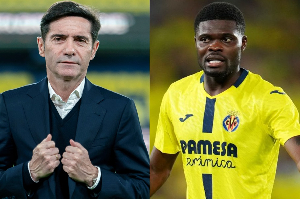
 Marcelino (L) criticised Partey's (R) performance
On a tensed Wednesday night in Germany, as Villarreal were dismantled by Bayer Leverkusen in the Champions League, Thomas Partey was hooked at half-time.
Within minutes of the final whistle, Marcelino did not hide his frustration.
The Ghanaian midfielder, he suggested, had failed to impose himself. He had been a shadow of the player Villarreal expected since his arrival in Spain from Arsenal.
It was a pointed assessment. Public. Direct. Uncomfortable.
Partey is not a rookie. He is a seasoned international, a player who has performed on the biggest stages for club and country. When a coach singles out someone of that profile, it is deliberate. It shapes narratives. It invites scrutiny. And in a struggling team, it quietly assigns responsibility.
Villarreal coach makes stunning revelation on Thomas Partey
Three days later, the narrative shifted.
Ahead of Villarreal’s 2-2 draw with Osasuna on Saturday, January 31, 2026, Marcelino revealed that Partey was not in the squad because he was experiencing discomfort in his pubic area. Suddenly, the underperforming midfielder had a physical explanation. The dip in sharpness. The reduced mobility. The subdued presence.
And that is where the questions begin.
In elite football, injuries, especially pubic and groin-related issues, do not appear overnight. They are managed, monitored, treated. If Partey had been struggling, as now confirmed, the coaching staff would have known.
Pubalgia is not minor soreness; it affects acceleration, balance, and the ability to turn sharply in midfield duels. It is the kind of injury players often try to push through for the sake of the team.
So, the question is unavoidable: if Villarreal’s staff knew Partey was managing an injury, why frame his Leverkusen display as a failure of performance rather than a limitation of fitness?
Managers speak often about unity, about protecting the dressing room. Public criticism has its place, but context matters. When a player is carrying a physical issue, transparency matters even more.
Otherwise, the narrative shifts from tactical honesty to something more troubling.
Was the Leverkusen defeat so damaging that someone had to be the symbol? Was the pressure of a five-game winless run searching for a visible outlet?
In dressing rooms, perception matters. So does trust.
Those close to Partey believe he had been soldiering on, trying to steady a team now winless in five matches. Instead of protection, he received criticism. Days later, he received an explanation, one that seemed to contradict the first.
And this is where leadership is tested.
A coach has every right to demand standards. But he also holds responsibility for the environment he creates.
If the same coach who questions a player’s sharpness later confirms he was physically compromised, it raises deeper concerns about communication, accountability and trust.
Football is ruthless. Managers protect results. Players protect reputations. But when the story changes within 72 hours, it inevitably raises doubts.
Is this a case of miscommunication? Or did the pressure of a poor run push a coach to single out a player he knew was compromised?
FKA/EB
Meanwhile, watch as the Ghana Hydro Authority speaks on warning systems and managing floods in the country:

Copyright © 1994 - 2026 GhanaWeb. All rights reserved.










