



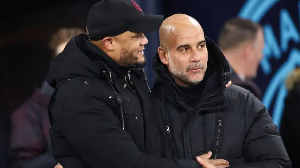
 Vincent Kompany won the Premier League four times with Manchester City
Vincent Kompany achieved so much as a player at Manchester City that he has a statue outside Etihad Stadium. With Bayern Munich, he is striving for greatness all over again.
His appointment as Bayern boss in May 2024 raised eyebrows. He had, after all, just taken Burnley down to the Championship.
But the move appears to have been a masterstroke. Under his guidance, Bayern won the Bundesliga last season. They are on course to retain their title, sitting 12 points clear at the top. And they hold a 2-1 lead over Real Madrid going into the home leg of their Champions League quarter-final on Wednesday.
As speculation continues over Pep Guardiola's future, Kompany's ties to Manchester City make him a potential future option for that job.
In the meantime, he is imposing his own style at Bayern, on and off the pitch.
There have been concerns among fans this season that the game's top teams, faced with stubborn man-to-man defensive set-ups, are taking a less risky approach in attack.
But Kompany's Bayern lean into that risk, playing freely both in and out of possession. They often dominate, and are exciting to watch - an approach that involves all 11 players and starts right from the back.
In the Champions League last 16, Bayern faced an Atalanta side who opted to man-mark across the pitch. So Kompany rotated his players around, dragging opposition defenders out of position.
For instance, attacking midfielder Serge Gnabry frequently dropped into centre-back positions to get on the ball. His Atalanta marker followed him. That opened up space for Gnabry's team-mates. As a result, Atalanta ended up with attackers in defence and defenders in attack. Bayern Munich won 10-2 on aggregate.
Juventus head coach Luciano Spalletti was particularly impressed, noting Bayern's fluidity. In his words: "They showed us a whole encyclopedia of movement and positioning in football."
If there is one idea that epitomises Kompany's Bayern, it is arguably movement off the ball.
As Bayern got into settled possession against Real Madrid in the first leg of their quarter-final, the back four in their 4-2-3-1 formation changed positions in a way that troubled their opponents.
Against Madrid's front two of Vinicius Jr and Kylian Mbappe, midfielder Joshua Kimmich dropped deep, forming a back three with the two centre-backs. This gave Munich a three-against-two overload.
Full-backs Josip Stanisic and Konrad Laimer then moved into narrower positions high up the pitch. Madrid defended in a narrow 4-4-2 and their wide midfielders, Arda Guler and Federico Valverde, were dragged to the centre of the pitch when marking Bayern's full-backs.
This opened up a direct passing lane for Bayern from the centre-backs to the wingers. Michael Olise often burst towards the ball, receiving it under minimal pressure, able to turn and drive at the heart of the defence with momentum.
These direct dribbles, paired with relentless running off the ball in behind a defence, naturally force opposing teams back towards their own goal.
And when that happens, Bayern are able to exploit the gaps in front of an opposing defence too.
For Bayern's second goal against Madrid, Olise's direct dribble, with Gnabry and Luis Diaz running in behind, pushed Real Madrid back. This opened up space for Harry Kane to take a deeper position - just as he has done many times throughout his career - before shooting unmarked at the edge of the box.
Bayern's approach works because the front three have skills that complement each other: Olise is a creator, Diaz is a runner, Kane is an impressive striker of the ball who can drop deep or attack the box.
It mirrors the dynamics of Barcelona's successful attack, featuring former Bayern striker Robert Lewandowski and wingers Lamine Yamal and Raphinha.

Copyright © 1994 - 2026 GhanaWeb. All rights reserved.










