



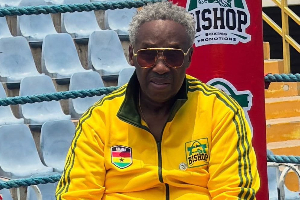
 Boxing promoter Dave Bishop
The humidity hangs thick over Bukom, the historic fishing community that has bred more Ghanaian boxing champions than any other patch of earth. Here, boys as young as seven shadowbox in dusty alleys, their bare feet slapping against cracked concrete, their eyes fixed on a future they can almost taste.
In this crucible of sweat and ambition, a man who has walked those same alleys for four decades has just accepted a new mission—one that has nothing to do with title belts or pay-per-view gates, and everything to do with the classroom.
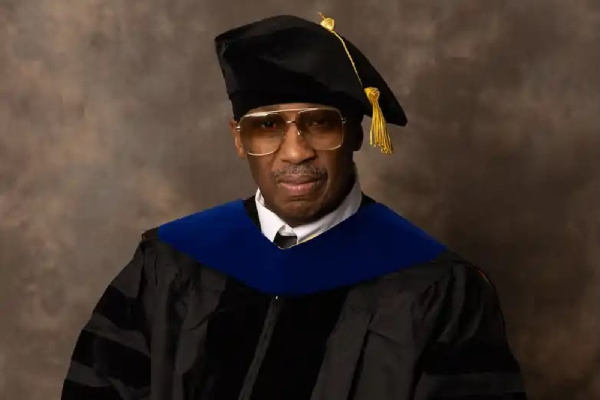
Dr Dave Bishop, the boxing promoter, community chief, and now, unexpectedly, an educational administrator, has been appointed Executive Chairman & Co-Director of Strategic Development and Institutional Partnerships at Prince De Henry Educational Complex.
The announcement, formalised last week, marks the latest—and perhaps most profound—turn in a life that has already defied every expectation. But this is not a story about a title. It is a story about a man who believes that the same discipline that builds champions in the ring can build citizens in the world, and that the only way to break the cycle of poverty is to teach a child not just to fight, but to think.
The Journey to the Classroom:
To understand why a 60-something boxing promoter—whose résumé includes managing former WBO Africa champion Wasiru Gyatabi Mohammed, guiding rising southpaw Majid Yakubu, and organising a Guinness World Record attempt—would suddenly pivot to educational administration, one must first understand the geography of his heart. Bishop is not a newcomer to development work. As Development Chief of Nyanfeku Ekroful in Ghana's Central Region, under the stool name Nana Ekow Amu II, he has already built teachers' quarters, sunk boreholes, and catalysed small businesses. He has received the President's Lifetime Achievement Award from Joe Biden himself, for over 4,000 hours of volunteer service. He holds an Honorary Doctorate from Kennedy University of France and is completing an MBA.
But those accolades, impressive as they are, never quite satisfied the restless energy that has driven him since his early days in Accra's sports scene. "I've promoted fights, managed fighters, and put on shows that packed the Bukom Arena," Bishop says, leaning forward in his office, his voice a low rumble. "But after the final bell, the fighters go home. Some of them have nothing to go home to—no education, no job, no plan. I realised I was giving them a moment of glory but not a lifetime of options. That had to change."
The partnership with Prince De Henry Educational Complex is the answer he has been searching for. The institution, located in the Greater Accra Region, has long prided itself on blending academic rigour with vocational training, but it lacked the athletic infrastructure and the community gravitas that Bishop brings. Together, they have sketched out an ambitious blueprint: a modern boxing gymnasium, an ICT centre equipped with 30 workstations, a scholarship fund for underprivileged youth, vocational workshops in tailoring and culinary arts, and an Eight-Week Boxing Education Certificate Programme that will teach not just technique but sports management, nutrition, and personal finance.
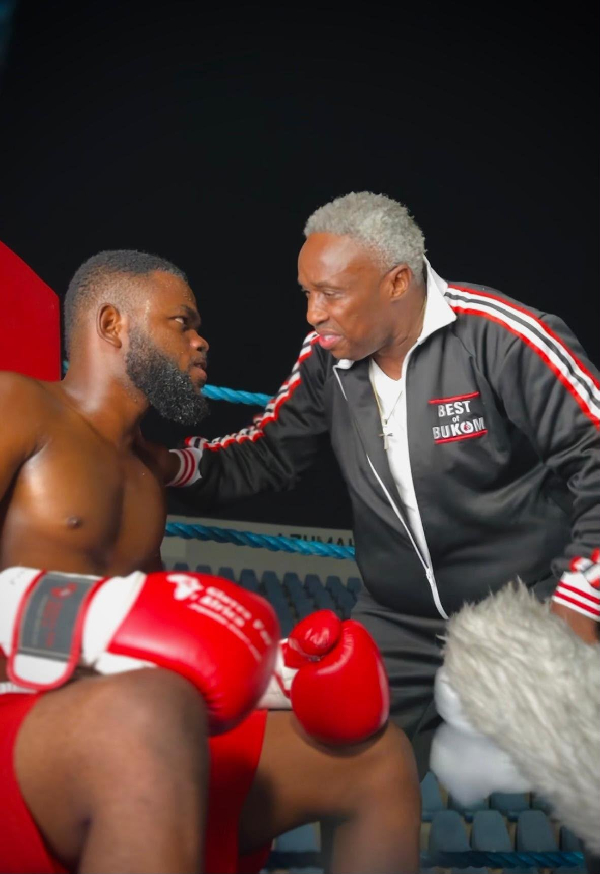
A Blueprint for Transformation:
The numbers are still modest—50 scholarship students in the first year, 20 certificate candidates, a gym that will take six months to complete—but Bishop thinks in decades, not quarters. "We are not building a quick-fix project. We are building a pipeline," he explains. "A child comes in at age 12, learns to box, but also learns to code. By 18, they have a high school diploma, a trade, and a national ranking. By 22, they are either a professional athlete with a management degree or a software developer who trains juniors in the evenings. That is sustainability."
The ICT centre, which will bear the name of his promotion company, Bishop Boxing Promotions, is a critical component. In a country where digital literacy remains a privilege of the urban elite, the centre will offer free after-school coding classes, basic computer skills, and online entrepreneurship courses. "Boxing pays the bills for a few dozen fighters," Bishop says. "Technology pays the bills for millions. I want our kids to have both."
The scholarship programme, meanwhile, will target the most vulnerable: children from fishing communities, single-parent households, and rural areas who would otherwise never step foot in a private educational complex. "Talent is everywhere," Bishop insists, "but opportunity is not. We are going to find the kids who have the heart but not the means, and we are going to give them a fighting chance—literally and figuratively."
The Ring and the Classroom: A Partnership:
Critics might question why a boxing promoter belongs in an academic setting. After all, boxing is often stereotyped as brutal and anti-intellectual. But Bishop has a ready rebuttal. "The discipline required to get up at 4 a.m. for roadwork, to count every calorie, to study an opponent's weaknesses for weeks—that is the same discipline required to study for an exam or to build a business plan. The ring teaches you to take a punch and keep moving forward. Life does the same. We are not teaching violence; we are teaching resilience."
That philosophy has already attracted allies. Prince De Henry's academic board, initially skeptical, has warmed to Bishop's vision after several planning sessions. "Dr. Bishop speaks the language of outcomes," says the Complex's headmaster, who requested anonymity to speak freely. "He doesn't just talk about 'empowerment'—he talks about job placement rates, certification pass rates, and measurable athletic progress. He is as data-driven as any educator I have met, and he brings a network of international contacts that we could never have accessed otherwise."
Indeed, Bishop's global reach is already opening doors. His connections with U.S.-based foundations, European sports academies, and corporate sponsors have sparked preliminary discussions about student exchanges, coach training programmes, and even a potential partnership with a British university for joint research on sport and youth development. "The 'Best of Bukom' brand is known internationally," he says, referring to his flagship event series. "Now I want the 'Prince De Henry' brand to be known for producing the next generation of African leaders."
Community Reaction: Hope, Skepticism, and a Demanding Test:
In Bukom, where Bishop is a familiar figure, the news has been greeted with a mix of euphoria and guarded optimism. "We have seen many promises come and go," says Nii Adjei Mensah, a senior elder who has watched generations of young men drift into informal gambling and street trading. "But Dr. Bishop is one of us. He has never forgotten where he came from. If he says he will build a gym and a school, I believe he will—but the proof will be in the first batch of graduates."
That proof will come quickly. The Eight-Week Boxing Education Certificate Programme is slated to launch in September 2026, with an inaugural class of 20 students selected through open trials and academic screenings. Simultaneously, the ICT centre is expected to be operational by November, with donated computers already being shipped from a partner organisation in the United States. The gym, which will be constructed on the Complex's grounds, is scheduled for completion in early 2027, with a grand opening that Bishop promises will feature international boxing dignitaries.
But Bishop is not waiting for ribbon-cutting ceremonies. In the coming weeks, he will begin a series of community town halls in Bukom, Tema, and Jamestown to recruit students, identify local trainers, and address concerns about safety and gender inclusion—a particularly sensitive issue in boxing. "Girls will be welcomed equally," he emphasises. "We already have several female amateur champions in Ghana who never got the support they deserved. That ends now."
A Legacy Beyond the Ring:
As the sun sets over Accra and the sounds of skipping ropes and heavy bags echo from makeshift gyms, Dr. Dave Bishop sits in his modest office, reviewing architectural plans for the new gym. On his wall hang photos of fighters he has managed, championship belts he has promoted, and the framed citation from President Biden. But his eyes keep drifting to a blank whiteboard where he has sketched a timeline for the next five years: 2026—pilot programme; 2027—gym opens, first ICT graduates; 2028—student exchanges begin; 2029—first cohort of scholarship students graduates from senior secondary; 2030—a decade of data, a generation transformed.
"Boxing gave me everything," he says, his voice softening. "It gave me purpose, discipline, and a platform. But it also showed me how fragile that platform is if you don't build something beneath it. I have seen too many fighters end up broke, broken, and forgotten. At Prince De Henry, we are not just building a gym. We are building a safety net—a ladder that lets a young person climb from the streets to a university, from a sparring partner to a coach, from a kid with a dream to an adult with a future."
He pauses, looks out the window at the bustling street below, where children are chasing a football, their laughter rising above the traffic. "That is my ultimate title," he says. "Not executive chairman, not chief, not doctor. Just someone who helped a few kids find their way. If I can do that, then every punch I ever threw, every fight I ever promoted, every sleepless night I ever had—it was all worth it."
The bell has rung on a new round, and this time, the fight is not for a belt. It is for a generation. And Dr. Dave Bishop is not just in the corner—he is in the centre of the ring, gloves on, ready to go the distance.

Copyright © 1994 - 2026 GhanaWeb. All rights reserved.










