



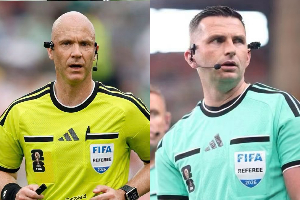
 Michael Oliver( R) and Anthony Taylor will not be allowed to officiate a game involving Argentina
The biggest games in world football are reserved for the best officials. Referees who reach the highest level are rewarded with the most important appointments, while those who fail to meet the required standard are left on the sidelines.
So, when a group of elite referees are suddenly ruled out of officiating a team at the World Cup, the natural assumption would be that their ability is the issue.
But in the case of England’s referees and Argentina, the reason has nothing to do with performance, reputation or trust in their decisions.
For decades, English officials have been prevented from taking charge of Argentina matches at major international tournaments and vice versa, not because they are considered inferior, but because of a history that stretches beyond football itself.
Adjetey, Partey and Others: Black Stars players who won back possession most often at the 2026 WC
It is a policy rooted not in football, but in a war. The reason lies 44 years in the past, on a remote group of islands in the South Atlantic.
In 1982, Britain and Argentina fought a 74-day conflict over the Falkland Islands, known in Argentina as Las Malvinas.
More than 900 people were killed before Britain regained control of the islands, but the dispute over sovereignty has never truly gone away.
Argentina still claims the territory, while Britain continues to administer it.
Recognising the political sensitivity between the two nations, FIFA adopted a long-standing neutrality policy. To eliminate even the slightest perception of bias, referees from England are not appointed to Argentina matches, while Argentine officials are similarly barred from taking charge of England games.
The rivalry was only intensified on the football pitch.
Just four years after the war, England and Argentina met in the 1986 World Cup quarter-finals. Diego Maradona's infamous "Hand of God" goal, followed moments later by what many regard as the greatest goal ever scored at a World Cup, sent Argentina through and left England furious.
The match became one of the most emotionally charged in football history, blending politics, history and sport into a single afternoon.
The tensions resurfaced in 1998 when David Beckham was sent off after an altercation with Diego Simeone during another World Cup meeting, a dismissal that contributed to England's penalty shootout defeat.
Four years later, Beckham found redemption by scoring the penalty that gave England a 1-0 victory over Argentina at the 2002 World Cup.
Now, with Argentina and England set to meet in the semi-finals of the 2026 World Cup, the long-standing rule has reached its most frustrating point for two of the game’s leading officials.
For Michael Oliver and Anthony Taylor, the 2026 World Cup journey has effectively been cut short.
They cannot take charge of an Argentina match, meaning they cannot referee the final if Argentina progress and they would face the same barrier if England reach the last match of the tournament.
It is a harsh reality for officials who have spent their careers earning the right to stand on football’s biggest stages.
A World Cup final appointment brings the ultimate recognition: a place in history, a medal and the honour of being chosen as the best of the best.
Instead, Oliver, Taylor will watch from the sidelines as another referee takes that opportunity, perhaps a colleague they have competed with for years, or even one they may feel they have outperformed.
But this is a burden they must accept. Their absence is not a judgement on their ability, their preparation or their standing in the game.
It is the consequence of a history that began decades before they reached the elite level of refereeing.
FKA/JE
GhanaWeb's Real Estate Platform will benefit property sector – Rev. Dr. Nanayaa Prempeh

Copyright © 1994 - 2026 GhanaWeb. All rights reserved.










