



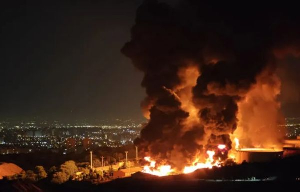
 Tehran oil facility under missile attack
The joint United States and Israeli military campaign against Iran, dubbed Operation Epic Fury, has entered a new and more destructive phase, with airstrikes now systematically targeting the country’s energy infrastructure and historic air assets.
As the conflict reaches its ninth day, the Israel Defense Forces (IDF) confirmed hits on multiple fuel storage facilities in Tehran that distribute fuel “to various consumers, including military entities in Iran.” Fars news agency reported that strikes hit four oil storage facilities and a production transfer center in Tehran and Alborz, killing four tanker drivers.
Footage geolocated by news agencies and circulating via Vahid Online showed massive plumes of smoke rising from a petrol storage facility in northeastern Tehran.
The Israeli military also announced it targeted a fleet of F-14 fighter jets—purchased from the US before the 1979 revolution—at Isfahan Airport, along with detection and air defense systems.
The strikes coincide with a deepening sense of progress within the Israeli security establishment. Former Israeli national security adviser Eyal Hulata, speaking as sirens echoed in the background, noted that the country is making “a lot of progress,” even as he was forced to seek shelter mid-interview.
Prime Minister Benjamin Netanyahu asserted that Israel and the US have achieved “almost complete control” over Iranian skies and warned that there are “many more targets and surprises prepared.”
Despite the escalating pressure on Tehran, retaliatory strikes against Gulf nations have not abated. The Kuwaiti Army reported a “wave of hostile drones” targeted fuel storage at Kuwait International Airport, triggering a “huge fire.” In downtown Kuwait City, the 22-story Public Institution for Social Security headquarters sustained “material damage” after being hit.
Two Kuwaiti border security personnel were killed on Sunday morning “while performing their national duty.”
Further south, Saudi Arabia’s Ministry of Defense reported intercepting at least 21 drones. In Bahrain, authorities reported the war’s first strike on a desalination plant, an Iranian drone attack that caused “material damage” to the critical water infrastructure.
The mixed messaging highlights significant divides following the death of Supreme Leader Ayatollah Ali Khamenei. Reports suggest the Assembly of Experts could choose a new figurehead within 24 hours. While some seek diplomacy, hardliners remain focused on revenge.
Pezeshkian appeared to backtrack on Sunday from his earlier conciliatory tone, threatening to step up attacks on American targets and accusing the US of “bullying” and “oppression.” Alex Vatanka, director of the Iran Program at the Middle East Institute, noted that while a new symbolic leader may be named, the Islamic Revolutionary Guard Corps (IRGC) will continue to play the “decisive role” in policy direction.
Ali Larijani, Iran’s top security official, claimed President Donald Trump thought he could repeat the “Venezuela model” in Iran but is now “stuck in the quagmire of his own miscalculations.” Larijani added that the US president “must pay the price” for the war.
Egypt’s Foreign Minister Badr Abdelatty warned that the escalation puts the region at a “critical juncture,” calling for immediate de-escalation. This follows Chinese Foreign Minister Wang Yi’s statement that “this was a war that should never have happened, and a war that benefited no one.”
President Trump, however, focused on domestic and allied obligations. After observing the dignified transfer of six US Army Reserve soldiers killed in Kuwait, he called it a “very sad day” but added that such deaths are “a part of war.” He also criticized the war.
Auto dealers respond to 15% price cut announcement

Copyright © 1994 - 2026 GhanaWeb. All rights reserved.










