



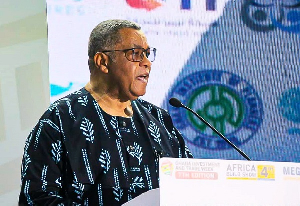
 Goosie Tanoh is the Coordinator of the 24-Hour Economy
Senior Presidential Advisor and Coordinator of the 24-Hour Economy and Accelerated Export Development Secretariat, Augustus Goosie Tanoh, has outlined the government's plan to transform Ghana into a production-driven economy through industrialisation, renewable energy, and value addition.
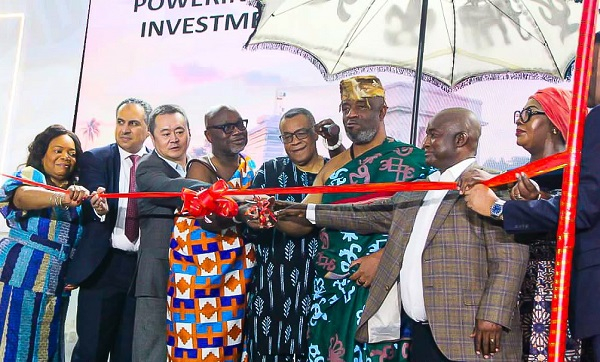
Speaking on behalf of the Presidency at the opening of the 7th Ghana Investment and Trade Week (GITW) in Accra on Tuesday, July 7, 2026, Tanoh said the 24-Hour Economy programme is designed to address Ghana's long-standing dependence on exporting raw materials while importing finished products by expanding domestic manufacturing capacity for both local and international markets.
"The 24-Hour Economy programme seeks to address Ghana's long-standing challenge of exporting raw materials while importing finished products by expanding domestic manufacturing capacity and increasing the production of goods for both local consumption and international markets," Tanoh stated.
He noted that although landmark energy and industrial projects established after independence laid the foundation for economic growth, Ghana has yet to fully realise its industrial potential.
According to him, increasing local processing and manufacturing remains critical to creating jobs, boosting exports, and building a more competitive economy.
Tanoh also identified affordable and reliable energy as one of the key pillars of the industrialisation agenda, revealing that the Secretariat is co-developing up to 1.5 gigawatts of utility-scale solar power backed by Battery Energy Storage Systems (BESS).
He disclosed that construction of the first 100-megawatt facility is expected to begin next month and will help reduce electricity costs for industries while enhancing the competitiveness of local manufacturing.
"Affordable and reliable energy is critical for industrial growth," he said, adding that the renewable energy initiative is expected to strengthen Ghana's industrial base.
He further revealed that the government's broader industrial strategy includes the development of the Volta-Oti Economic Corridor, which will feature agro-industrial parks, carbon-neutral oil palm plantations, renewable energy-powered transport systems, compressed biogas facilities, and waste-to-energy projects.
According to Tanoh, these initiatives are expected to support job creation and contribute significantly to the government's target of creating seven million jobs by 2028.
The event also featured the Ga Mantse, King Tackie Teiko Tsuru II, who encouraged both local and foreign investors to take advantage of Ghana's political stability and investment opportunities. He also called for stronger collaboration among traditional authorities, the government, and the private sector to promote sustainable economic growth.

ANAS/MA
Inside the AI revolution that could save lives on Ghana's roads

Copyright © 1994 - 2026 GhanaWeb. All rights reserved.










