



 The OP8 programme builds on UNDP’s long-standing commitment
The United Nations Development Programme (UNDP), through the Small Grants Programme funded by the Global Environment Facility (GEF), has formalised support for 18 selected Civil Society Organisations (CSOs) and Non-Governmental Organisations (NGOs) working along the Black Volta Basin across the Savannah, Bono and Upper West Regions to address critical environmental challenges, improve livelihoods, and strengthen community resilience.
With a total grant allocation of $457,000 (approximately GH¢5 million), the funded initiatives will promote community-based conservation, enhance sustainable agriculture, fisheries and food security, expand access to low-carbon energy, and strengthen local-to-global coalitions on chemicals and waste management to advance national priorities and the attainment of the Sustainable Development Goals (SDGs).
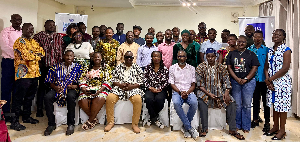
The implementation of the eighth Operational Phase (OP8) of the GEF Small Grants Programme officially commenced with a grant agreement signing ceremony, paving the way for the implementation of community-led environmental initiatives across the Black Volta Basin.
The event also featured an inception workshop that brought together all 18 selected CSOs and NGOs. The workshop strengthened participants’ understanding of project implementation modalities, monitoring and reporting requirements, fiduciary responsibilities, communication and visibility guidelines to ensure effective programme delivery and accountability.
Speaking at the signing ceremony, Dr Abdul Razak Saeed, Head of Environment and Climate at UNDP Ghana, emphasised the importance of innovative financing in strengthening community-led development efforts and sustaining environmental action at the grassroots level.
“Innovative financing is transforming the way development is delivered. It is shifting us beyond traditional aid models and positioning civil society organisations as strategic partners that connect communities to sustainable development outcomes and long-term impact. Through initiatives like the GEF Small Grants Programme, we are investing in local leadership and solutions that will continue to deliver environmental and socio-economic benefits for generations to come.”
The OP8 programme builds on UNDP’s long-standing commitment to supporting community-based initiatives that generate global environmental benefits while improving local livelihoods. Through this phase, the GEF Small Grants Programme continues to strengthen partnerships with civil society organisations and grassroots actors working at the forefront of environmental stewardship and community development.
The selected projects span a broad range of strategic intervention areas, including community-based biodiversity conservation; conservation of threatened ecosystems and species; landscape restoration and sustainable land management; climate-smart agriculture; sustainable land and forest management; food security; climate change mitigation and resilience; wetland and riparian ecosystem restoration; and low-carbon livelihood development.
Through these interventions, participating organisations will work with communities to restore degraded landscapes, protect critical habitats, promote sustainable agricultural practices, strengthen ecosystem stewardship, and create livelihood opportunities that reduce pressure on natural resources.
The projects highlight the important role local organisations play in advancing environmental sustainability while improving the well-being and resilience of communities along the Black Volta Basin landscape. The CSOs and NGOs will serve as platforms for this change and are expected to ensure an inclusive and participatory approach to implementation.
Representing the beneficiary organisations, Louis Kuuyebir, Finance and Operations Manager at the Tuna Women Development Project, welcomed the support and reaffirmed the commitment of participating organisations to delivering impactful, community-driven environmental solutions.
“We are grateful to UNDP Ghana, the GEF Small Grants Programme and our partners for this investment in community-led action. This support will strengthen our efforts to protect the environment, improve livelihoods, and build a more resilient future for communities across the Black Volta Basin,” said Kuuyebir.
As implementation begins, the supported projects are expected to contribute to the restoration of degraded landscapes, conservation of biodiversity, improved food security, enhanced climate resilience, and the creation of sustainable livelihood opportunities for communities across the Black Volta Basin.
The projects are expected to be implemented from July 2026 and will run until mid-2028.
The Small Grants Programme (SGP) is a corporate programme of the Global Environment Facility (GEF) implemented by the United Nations Development Programme (UNDP). Established in 1992, SGP is currently active in 127 countries and promotes community-based innovation, capacity development, and empowerment through projects led by local civil society and community-based organisations, with special consideration for Local Peoples, women, youth, and persons with disabilities.
SGP has supported more than 28,000 community-based projects on biodiversity conservation and sustainable use, climate change mitigation and adaptation, sustainable land management, conservation of international waters, and chemicals and waste management, while generating sustainable livelihoods.

Copyright © 1994 - 2026 GhanaWeb. All rights reserved.










