



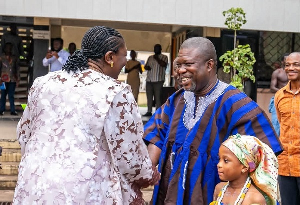
 The two made the call during a meeting at the Volta Regional Coordinating Council
The Volta Regional Minister, James Gunu, and the High Commissioner of Namibia to Ghana, Ndiyakupi Nghituwamata, have called for a new generation of Ghanaian and Namibian leaders to shift the focus of the two countries from political liberation to economic independence.
According to them, while previous generations successfully fought for political freedom and national sovereignty, the responsibility of the current generation is to build strong economies capable of creating decent jobs, developing human capital and improving the living standards of citizens.
The two made the call during a meeting at the Volta Regional Coordinating Council when the Namibian High Commissioner paid a courtesy visit to the region as part of her three-day familiarisation tour.
Gunu said Ghana and Namibia had a long history of political solidarity, particularly Ghana’s contribution to Namibia’s liberation struggle, but argued that the relationship must now be transformed into practical economic cooperation.
“Our previous generations fought for political freedom. Today’s responsibility is to achieve economic independence, create decent jobs, develop human capital and improve the living standards of our people,” he stated.
He said Ghana and Namibia should therefore aim to “prosper together, not only struggle together,” stressing that the historic friendship between the two countries should translate into tangible opportunities for their people.
The Minister identified trade, investment, tourism, skills development, entrepreneurship, youth opportunities and cultural cooperation as key areas where the two countries could deepen their relationship.
He urged Ghanaian businesses to explore opportunities in Namibia while encouraging Namibian businesses to consider Ghana, particularly the Volta Region, as a gateway to the West African market.
Gunu also called for greater collaboration among universities, technical and vocational institutions, tourism operators and young entrepreneurs in the two countries.
He said such partnerships could facilitate knowledge transfer, skills development, business exchanges and the creation of new opportunities for young people.
Volta Economic Corridor
The Minister explained that Ghana’s emerging 24-hour economy also presented opportunities for deeper economic cooperation, particularly through the Volta Economic Corridor Project.
He said the project was designed to harness the economic potential of the Volta Lake, which extends about 400 kilometres from the southern to the northern parts of Ghana.
According to him, the development of water transportation, large-scale irrigation farming, tourism and aquaculture could open up significant opportunities for investment, employment and regional economic growth.
Gunu said the Volta Region was prepared to strengthen its engagement with Namibia and turn the High Commissioner’s visit into meaningful partnerships.
‘Win the economic battle’
For her part, Nghituwamata strongly echoed the Minister’s position, saying the time had come for the younger generation to take the historic relationship between Ghana and Namibia from the political arena to the economic front.
She said Namibia’s liberation and independence were closely connected to Ghana’s support during the anti-colonial struggle, particularly under Ghana’s first President, Osagyefo Dr Kwame Nkrumah.
“Remember, our forefathers are saying they have won the political battle. It’s now for us to win the economic battle,” she stated.
Nghituwamata said her visit to the Volta Region was intended to identify areas where Namibia and the region could work together to create economic opportunities.
“I want to see what the Volta Region can offer to Southern Africa, to Namibia in particular,” she said.
She identified agriculture, tourism, fisheries, entrepreneurship, cross-border trade and the region’s proximity to the Atlantic Ocean as areas with significant potential for collaboration.
The High Commissioner proposed business-to-business and institution-to-institution partnerships, including twinning arrangements between regions in Ghana and Namibia.
She also suggested tourism exchanges and increased visits between the two countries to enable businesses and institutions to identify practical areas for cooperation.
According to her, the Namibia-Ghana relationship had already produced positive results, but the current generation needed to build on the foundation established by their forebears.
The High Commissioner said Namibia was particularly interested in understanding the economic strengths of the Volta Region and connecting businesses and institutions to counterparts in Namibia.
Agriculture and tourism
The Volta Region’s agricultural potential was also highlighted as a possible area of economic partnership.
The Volta Regional Director of Agriculture, William Dzemefe, said the region produces about 23 percent of Ghana’s rice, in addition to cassava, vegetables, groundnuts and livestock.
He added that the region produces more cattle per cubic metre than the northern part of the country.
He said the region had opportunities in agribusiness, value addition, ecotourism and livestock development that could benefit from international partnerships.
Dzemefe further suggested that Namibia’s experience in wildlife management could complement the Volta Region’s growing ecotourism sector.
Local-level cooperation
The Dean of Volta Regional MMDCEs, Jerry Ameko, who was also present at the event, noted that interactions between cities and districts across borders could help build relationships that contribute to lasting peace.
“When cities or districts from different countries come together, we believe the relationship built out of that promotes lasting peace across the globe,” he said.
He called for formal partnerships between districts and municipalities in the Volta Region and their counterparts in Namibia to promote knowledge sharing, cultural exchange and the adoption of best practices.
He said such partnerships would not only strengthen local governance but also bring communities from different countries closer together, creating deeper understanding, friendship and mutual respect.
The shared position of the Minister and the High Commissioner signals a growing desire to redefine Ghana-Namibia relations around economic empowerment, practical cooperation and shared prosperity.

Copyright © 1994 - 2026 GhanaWeb. All rights reserved.










