



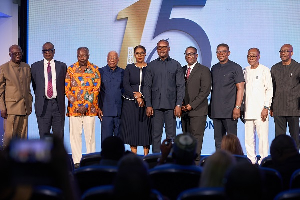
 Hardcastle highlighted the Commission's contribution to indigenous participation in the upstream
The Petroleum Commission says it has saved the state approximately US$2 billion through its review of Plans of Development (PoDs) and related petroleum projects since its establishment 15 years ago.
Chief Executive Officer of the Petroleum Commission, Emeafa Hardcastle, disclosed this in Accra on Tuesday, August 18, 2026, during the launch of the Commission’s 15th anniversary celebrations.
According to her, the savings included US$210 million from the Jubilee Plan of Development Phase 1A, US$510 million from the TEN Plan of Development, US$200 million from the review of OCTP SURF and T&I, and US$1 billion from the Greater Jubilee Full Field Development Plan.
“The Petroleum Commission has over the years maintained efficient stewardship of Ghana’s hydrocarbon resources and has saved the State millions of dollars, translating into enhanced revenue to the State from exploitation of our hydrocarbons,” she said.
Jubilee, TEN partners commit $2 billion to further oil field development – Dr Jinapor
Hardcastle added that a recent petroleum cost audit on one contract area uncovered infractions amounting to US$229 million.
She said the amount had been struck out of the pool of allowable petroleum costs, creating potential gains for the state through future Corporate Income Tax and Additional Oil Entitlement.
The Commission, she added, had strengthened oversight of contractors’ expenditure through the approval of work programmes and budgets to ensure petroleum operations were undertaken at optimised costs.
Hardcastle highlighted the Commission’s contribution to indigenous participation in the upstream petroleum industry as another major achievement.
She said the Commission had supervised the award of US$4.9 billion worth of contracts to indigenous Ghanaian companies, representing 22 per cent of total contracts.
A further US$7.9 billion in contracts had been awarded to joint venture companies involving Ghanaian businesses, representing 35 per cent of total contracts.
She said the implementation of the Petroleum (Local Content and Local Participation) Regulations, 2013 (L.I. 2204), and its amendment had helped drive local participation and in-country value addition.
Several industrial establishments, including cementing units, waste management plants, fabrication yards, manufacturers of bolts, nuts and valves, and aviation hangars, had emerged.
“In terms of job role localisation, and given the age of the industry in Ghana, we have done relatively well,” Hardcastle said.
She noted that available data indicated a job-role localisation rate of more than 90 per cent, with Ghanaians increasingly occupying core technical and managerial positions.
Five new petroleum agreements
Looking ahead, Hardcastle announced that Ghana is expected to sign at least five new petroleum agreements between this year and early 2027, subject to parliamentary approval of proposed legislative and fiscal reforms.
“It is anticipated that at least five new petroleum agreements will be signed between this year and early next year,” she said.
She added that the frontier offshore Accra-Keta Basin was expected to attract oil majors for exploration.
Hardcastle said the Commission was working with the Ministry of Energy and Green Transition to review Ghana’s upstream legislative, regulatory and fiscal framework to make the sector more competitive.
Production decline
The CEO also disclosed that the Commission was taking steps to address declining oil production and improve Ghana’s reserve replacement ratio.
She said the Commission was working with operators of the Jubilee, TEN and Sankofa-Gye Nyame fields, with production from the Jubilee fields showing a steady increase in recent months.
Hardcastle said discussions with TEN partners would be revived on Infrastructure-Led Exploration to improve the field’s viability.
She further disclosed that the Commission was working to facilitate development of the Eban-Akoma and Afina discoveries, while engaging operators on Plans of Development.
The Commission was also working to ensure the Pecan Field development commenced as soon as possible after outstanding challenges were resolved.
“Recognising that no new field has been brought onstream since the Sankofa Gye Nyame in 2017, the Commission is hastening to revise this narrative,” she said.
Voltaian Basin
The Petroleum Commission is developing a strategy to guide petroleum exploration and exploitation in the Voltaian Basin.
Hardcastle said the strategy was necessary because onshore petroleum operations presented different technical and operational dynamics from offshore activities.
“This is critical, especially when the dynamics of onshore exploitation differ significantly from offshore,” she said.
The strategy document will be submitted to the Minister of Energy and Green Transition for consideration.
Reflecting on the Commission’s 15-year journey, Hardcastle said it had established itself as a strong regulatory body while maintaining Ghana’s position as an attractive investment destination.
“Today, the Commission serves as a benchmark for petroleum regulatory frameworks across the African continent,” she said.
She highlighted the Commission’s role in developing upstream petroleum regulations, providing technical advice to the Energy Minister and establishing a centralised National Data Repository.
The repository houses seismic, well and geotechnical data from Ghana’s sedimentary basins, including the Tano, Keta and Voltaian basins.
Hardcastle said the Commission had also strengthened regulatory cooperation with Uganda, Liberia, Nigeria and The Gambia, while providing technical support to countries including Guyana and Suriname.
MA

Copyright © 1994 - 2026 GhanaWeb. All rights reserved.










