



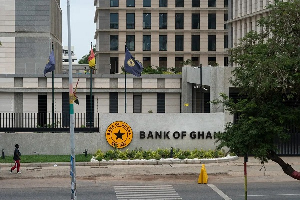
 The Bank of Ghana headquarters
The Bank of Ghana (BoG) recorded a combined loss of GH¢9.05 billion from its Gold for Reserves and Gold for Oil programmes in 2025, while the International Monetary Fund (IMF) estimates operational losses of more than US$1.7 billion from the Domestic Gold Purchase Programme, Economic policy analyst Kwabena Nyantakyi has said.
In a technical analysis, Nyantakyi said the BoG’s audited financial statements showed a loss of GH¢8.84 billion from the Gold for Reserves programme and GH¢203.034 million from the Gold for Oil programme.
He cautioned, however, that the BoG figures and the IMF’s August 2026 estimate should not be added together, as they represent different measures of the programme’s financial impact.
According to him, the IMF’s estimated operational losses of more than US$1.7 billion are equivalent to about 1.5% of Ghana’s GDP and 17% of the value of doré transactions.
Nyantakyi noted that the Ghana Gold Board Act, 2025 (Act 1140), which was assented to on April 2, 2025, made GoldBod the sole authority responsible for purchasing, selling and exporting gold outside the large-scale mining sector. The Act also transferred the assets of the Precious Minerals Marketing Company to GoldBod.
He stressed, however, that the legislation did not transfer the Bank of Ghana’s historical losses or its reserve management mandate, meaning the 2025 losses remained on the central bank’s books.
Exchange-rate spread drove losses
According to Nyantakyi, the losses were not primarily caused by a fall in gold prices, as gold prices reached record levels in 2025, rising by about 41%.
He cited the IMF’s assessment that a major source of the losses was the exchange-rate spread. Gold was reportedly purchased using a cedi exchange rate linked to forex bureau rates but sold at the BoG’s lower reference rate, with additional costs arising from fees and discounts offered to off-takers.
Despite the financial losses, Nyantakyi said the programme delivered significant economic benefits.
He said the BoG purchased and exported about 104 tonnes of artisanal and small-scale gold valued at US$10.9 billion in 2025 and sold about US$10.6 billion into the foreign exchange market.
He said the transactions helped rebuild Ghana’s international reserves, support the appreciation of the cedi and ease inflationary pressures.
The formalisation of gold purchases also helped narrow the gap between Ghana’s recorded gold exports and imports reported by destination countries, he added.
Nyantakyi said the stronger cedi further helped ease pressure on the energy sector, where many Independent Power Producer obligations are denominated in US dollars.
However, he cautioned against attributing Ghana’s economic stability entirely to the gold programme, noting that fiscal consolidation, monetary tightening, debt restructuring and high global commodity prices also contributed.
Environmental and revenue costs
Nyantakyi warned that the official loss figures do not capture environmental costs and tax expenditures associated with the programme.
He cited IMF concerns about environmental degradation linked to illegal mining, popularly known as galamsey, as well as an estimated GH¢2 billion in forgone revenue following the abolition of the 1.5% withholding tax on small-scale gold.
He also raised concerns about concentration risks, noting that one aggregator accounted for more than 60% of artisanal gold exports in 2025.
Call for stronger safeguards
Nyantakyi called for reforms to improve the programme’s financial sustainability and transparency.
Among his recommendations are a single market-consistent exchange-rate rule, transparent doré tenders, publicly stated reserve adequacy targets and clear risk limits for GoldBod.
He also proposed a quarterly public dashboard showing gold volumes, prices, fees, counterparties and foreign exchange proceeds.
He urged Ghana to use the benefits from its gold resources to finance environmental restoration and diversify the economy into sectors capable of creating sustainable jobs.

Copyright © 1994 - 2026 GhanaWeb. All rights reserved.










