



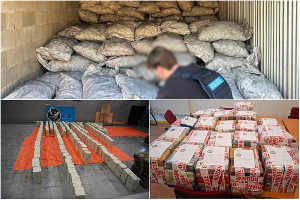
 The cases span multiple routes and drug types, raising questions about the networks involved
The Herald's investigation into the US$261.45 million cocaine seizure in France has uncovered what sources describe as a potentially significant development: a large consignment of illicit drugs allegedly remains in Ghana, with attempts being made to move it to Europe and other destinations.
The Herald has been following links between recent international drug seizures and Ghana’s suspected role in a transnational cocaine trafficking network, following eight major transnational drug busts linked to Ghana over 17 months, with at least 12.7 tonnes of cocaine and suspected cocaine seized in reported cases.
The cases span multiple routes and drug types, raising questions about the networks involved in moving narcotics through Ghana and the effectiveness of international cooperation in combating transnational drug trafficking.
According to insiders familiar with the matter, a huge consignment of narcotic drugs arrived in Ghana shortly before the Akufo-Addo administration's departure in January 2025. The sources claim that the drugs have since encountered difficulties in being moved out of the country.
The allegations raise fresh questions about Ghana's role in the international narcotics trade, particularly following a series of major drug seizures in Europe and Australia involving consignments traced to Ghana.
The Herald could not independently verify the alleged presence of the consignment or establish its precise location in the country. However, French and Dutch investigators have established links between a nearly 3.9-tonne cocaine shipment seized last week at the port of Dunkirk in France and the criminal organisation of fugitive Dutch drug kingpin Jos Leijdekkers, alias "Bolle Jos", who is hiding in Sierra Leone, West Africa.
The cocaine, concealed in a container of plastic waste shipped from Ghana, had an estimated street value of €225 million, equivalent to approximately US$261.45 million.
Part of the consignment was reportedly destined for Antwerp, Belgium. Belgian customs was reported to have tipped off the French, resulting in the arrest.
The development has heightened scrutiny of Ghana's ports and of the country's possible role in the movement of large consignments of narcotics to international markets.
The Herald's sources have raised suspicions that "Bolle Jos" may be keeping his cocaine in Ghana and exploiting weaknesses in the port and shipping systems to facilitate its movement to Europe and other destinations.
However, the claim that the fugitive is storing cocaine in Ghana has not been independently established beyond the large narcotic shipments from the country into Europe and Australia, some of which involve UK citizens.
The latest French seizure follows a series of major drug interceptions involving shipments traced to Ghana, prompting questions about the scale of the alleged trafficking network and the effectiveness of current controls.
The eight major transnational drug seizures linked to Ghana between April 2025 and September 2026 have highlighted the country's alleged role as a transit hub for international drug trafficking.
The cases, compiled from media reports and official statements, involve seizures in Ghana, the Netherlands, Belgium, Australia, and France, with consignments reportedly destined for Europe, the United Kingdom, Dubai, and Australia.
The seizures include at least 12.7 tonnes of cocaine and suspected cocaine, along with 320 kilograms of methamphetamine and cannabis consignments. The cases are outlined in a timeline spanning April 2025 to September 2026.
The first incident occurred on March 4, 2025, when the National Intelligence Bureau (NIB) intercepted a truck carrying around 120 slabs of cocaine valued at approximately US$150 million along the Takoradi–Cape Coast highway.
President John Dramani Mahama had barely taken office when this illegal operation occurred. It was believed that the cartel was taking advantage of the political transition between the Akufo-Addo government and the incoming Mahama administration.
On April 23, 2025, 89.74 kilogrammes of suspected cocaine, packaged in 73 slabs, were intercepted at Kotoka International Airport in Accra. The consignment was allegedly destined for the Netherlands.
On May 18, 2025, a further seizure at the same airport involved 17.72 kilogrammes of drug consignment and 53.60 kilogrammes of cannabis, with the United Kingdom and Dubai identified as destinations.
On June 13, 2025, approximately 4.5 tonnes of cocaine linked to Tema, Ghana, were reportedly seized in Amsterdam, the Netherlands.
The series continued in December 2025, when Belgian authorities reportedly seized 2.829 tonnes of cocaine in Antwerp on December 2. The consignment was linked to Tema.
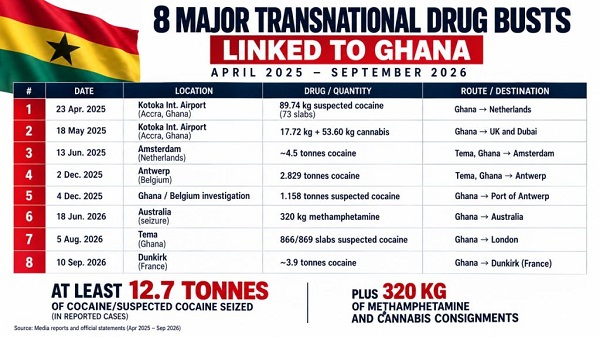
Two days later, on December 4, 2025, a Ghana-Belgium investigation reportedly involved 1.158 tonnes of suspected cocaine destined for the Port of Antwerp.
On June 18, 2026, Australian authorities reportedly seized 320 kilogrammes of methamphetamine linked to Ghana.
Another reported case emerged on August 5, 2026, involving 866/869 slabs of suspected cocaine in Tema, with London identified as the intended destination.
The latest case in the compilation occurred on September 10, 2026, when approximately 3.9 tonnes of cocaine, concealed in a container of plastic waste shipped from Ghana, was reportedly seized at Dunkirk, France.
The compilation, however, represents reported seizures and does not, by itself, establish that all the consignments were handled by one criminal organisation or that every shipment originated in Ghana.
The Narcotics Control Commission (NACOC) has arrested three suspects following the seizure by French customs of nearly 3.9 tonnes of cocaine concealed in a container that arrived from Ghana.
The suspects are alleged to have represented and facilitated the activities of Jos Leijdekkers, popularly known as “Bolle Jos”, in Ghana.
In a statement issued on Monday, September 14, 2026, NACOC said the arrests followed the reported seizure of the cocaine shipment at the port of Dunkirk in France.
The Commission said the suspects were in its custody and were assisting investigators as inquiries continued into their alleged roles in the trafficking operation.
NACOC said the arrests reaffirmed its position that Ghana would not be allowed to become a safe haven, transit point, or operational base for international drug trafficking organisations.
It said it would continue to work with domestic and international law enforcement partners to disrupt the people, finances, and infrastructure sustaining the illicit drug trade.
The Commission also assured that the rights and legal protections of all persons under investigation would be safeguarded.
The latest developments have intensified calls for closer scrutiny of the movement of containers through Ghana’s ports, the activities of shipping agents, and the possible use of legitimate cargo to conceal narcotics.
For The Herald, the central unanswered question remains whether the alleged consignment said to be stranded in Ghana is connected to the wider network implicated in the recent international seizures.
Until investigators establish the whereabouts of the alleged drugs and identify those responsible for their movement, the claim remains an unverified allegation.

Copyright © 1994 - 2026 GhanaWeb. All rights reserved.










