



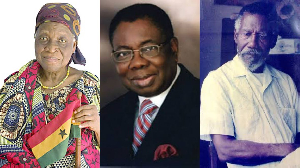
 Theodosia Okoh, Philip Gbeho and Amon Kotei gave the country its identity
Every year on March 6, Ghana celebrates its Independence Day, marking the moment the country broke free from colonial rule in 1957.
The day often centres on the political figures who led the struggle for freedom, particularly Kwame Nkrumah and other nationalists who fought for self-governance.
But beyond the political fight for independence, there were also creative minds whose work helped shape Ghana’s identity as a new nation.
Their art, music, symbols, and literature became part of the country’s national image.
Theodosia Okoh
One of the most visible symbols during Independence Day celebrations is the Ghana flag, designed by Theodosia Okoh.
As Ghana prepared for independence in 1957, the country needed a flag that would represent its freedom and national identity. Theodosia Okoh submitted a design that was later selected as the official national flag.
Her design featured three horizontal stripes of red, gold, and green with a black star at the centre. Each colour carried meaning: red symbolised the blood of those who fought for freedom, gold represented the country’s mineral wealth, and green reflected Ghana’s rich forests and natural resources. The black star became a symbol of African freedom and unity.
LIVESTREAMING: Ghana marks 69th Independence Day celebrations
Philip Gbeho
Before an official Independence Day parade begins, the national anthem rings out to welcome the President and mark the start of the ceremony.
The original anthem adopted at independence, “God Bless Our Homeland Ghana”, was composed by Philip Gbeho, with lyrics written by Emmanuel Pappoe-Thompson.
Amon Kotei
Another national symbol created during the independence era is the Coat of Arms, designed by Amon Kotei.
Amon Kotei, a respected Ghanaian artist, was commissioned to create the emblem in 1957 as the country prepared to become independent.
The Coat of Arms, which appears on official government documents and institutions, features a shield divided into four sections by a green St. George’s Cross edged in gold.
Each section represents key aspects of Ghana’s identity, including political authority, natural resources, and national unity.
Kofi Antubam
Kofi Antubam also played a major role in shaping Ghana’s visual identity after independence.
Appointed as the official state artist by President Nkrumah, Antubam helped design important national regalia.
His work included the presidential mace and ceremonial seat, which symbolised the authority and sovereignty of the Ghanaian state.
Ephraim Amu
Music also played a role in defining Ghana’s national spirit. Ephraim Amu is widely known for composing the patriotic song “Yɛn Ara Asaase Ni”.
Although not the official anthem, the song has become one of the most recognised patriotic compositions in Ghana and is often performed during national celebrations, including Independence Day events.
Writers who told the Ghanaian story
Beyond national symbols and music, Ghanaian writers also helped define the country’s identity by telling its stories through literature.
Writers such as Efua Sutherland, Ayi Kwei Armah, Amu Djoleto, Kwesi Brew, Kofi Awoonor, Ama Ata Aidoo, and Lade Wosornu captured the Ghanaian experience in their works.
Through plays, novels, and poetry, they documented Ghanaian traditions, struggles, and aspirations, helping to shape the cultural narrative of the nation.
Nana Agradaa arrives at Heaven Way Champions Church after 8 months in prison
AK/EB

Copyright © 1994 - 2026 GhanaWeb. All rights reserved.










