



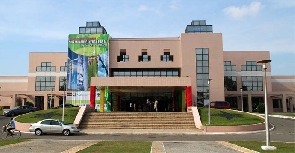
 File photo of the Accra International Conference Centre
GhanaWeb Feature by Isaac Dadzie
When the Telecel Ghana Music Awards organisers, Charterhouse, announced that the 27th edition of the prestigious ceremony would not be held at the Grand Arena at the Accra International Conference Centre, followers of the awards knew something had shifted.
The Grand Arena, with a seating capacity of roughly 4,500, had become synonymous with the glamour and scale the TGMAs demanded.
But this year, that option was unavailable. Renovation works had taken the venue offline, forcing Charterhouse to settle for an alternative venue, the Palms Convention Centre, that seats fewer than 2,500 guests.
For an awards show that prides itself on production quality, artistic prestige, and an ever-growing industry audience, the downgrade was more than just a logistical inconvenience.
It was a symptom of a far deeper problem, one that Ghana's entertainment industry has been quietly choking on for years.
'Give us Grand Arena' - Charterhouse appeals to Mahama over TGMA 2026 venue
A vanishing list
Ghana's stock of functional, large-scale event venues has never been particularly impressive. But in recent years, what is left has been steadily eroded.
The Accra International Conference Centre, which used to be home to grand events, is currently undergoing renovation.
The National Theatre, one of the few genuinely iconic performance spaces in the country, is also in the middle of a refurbishment that has kept it largely inaccessible to event organisers.
Then there is the Fantasy Dome at the Trade Fair Centre, a venue that once served as one of Accra's most versatile indoor event spaces. It was demolished in 2024, under circumstances that remain strange.
What remains is a thin and overstretched list. For sit-down events, organisers largely have to choose between the UPSA Auditorium, the National Theatre when available, and the AICC.
For open-air concerts, the Ghud Park, Laboma Beach, the La Palm Royal Beach gardens and Untamed Empire.
These venues have served the industry well enough, but they were never designed to carry the full weight of a national entertainment calendar that keeps growing year on year.
Demolition of Fantasy Dome at Trade Fair was unfair – Mark Okraku-Mantey
When stadiums step in, and fall apart
In the absence of purpose-built concert infrastructure, promoters have increasingly turned to sports facilities to fill the gap.
The Accra Sports Stadium has hosted some of the country's biggest musical moments, including concerts by Stonebwoy, Shatta Wale and Medikal, but the arrangement comes with significant trade-offs.
Sports stadiums are not designed for concerts. Hosting a large-scale music event at such a facility demands additional investment, extra sound and lighting infrastructure, extended security personnel, crowd management logistics, and even pitch covers.
The costs are not favourable to promoters, and the results are not always kind to the facilities either.
In December 2025, during the GTBank Music Concert, some fans, overwhelmed by the crowd and desperate for a glimpse of their favourite artistes, caused a stampede that damaged sections of the Accra Sports Stadium.
Back in 2024, videos captured motocycle stunt riders ruining sections of the pitch.
These were illustrations of what happens when demand for live entertainment collides with infrastructure that was simply not built for it.
Not just Accra
The venue crisis is not just confined to Accra. Ghana's second and largest city, Kumasi, has long harboured one of the country's most passionate music audiences and some of its most underserved event infrastructure.
Sarkodie's decision to take his flagship Rapperholic concert to Kumasi in 2026 was widely celebrated as a milestone moment, a signal that Accra's monopoly on major music events could be broken.
But then the problems began, the search for a suitable venue in Kumasi that could host an event of Rapperholic's scale.
They were confined to the Baba Yara Sports Stadium and further restricted to just a section, barely 25% of the stadium, due to the unavailability of pitch covers.
The same story plays out across the country's regional capitals.
Promoters who attempt to decentralise Ghana's entertainment industry find themselves confronted not by a lack of audience but by a lack of infrastructure to host them properly.
The TGMA's uncomfortable mirror
The Telecel Ghana Music Awards hold a unique position in Ghana's entertainment calendar.
The ceremony is not merely a 'speech and prize-giving ceremony'; it is a statement of industry. Every production detail, from staging to lighting to sound to seating, is a reflection of how seriously Ghana takes its own music.
Charterhouse has, over 25 years, built the TGMAs into a broadcast event that commands national attention.
To watch that event now contend with a venue capacity of under 2,500, a step down from the Grand Arena's 4,500, is to see the infrastructure crisis in full glare of the world.
Industry stakeholders, media personalities, artistes and their teams who would ordinarily fill those seats are squeezed out.
And the message, however unintentional, is that Ghana's biggest night in music is being hosted in a space too small to contain it.
A ‘dim’ light at the end of a long tunnel
The picture is not entirely bleak. There are signals that the conversation is beginning to shift.
Mr Eazi, the Nigerian-Ghanaian music entrepreneur who has made Ghana something of a second home, has publicly expressed interest in developing event centres across the country.
GTA should give me land and I will build a proper event space in Accra – Mr Eazi
The ongoing renovations at the AICC and the National Theatre, frustrating as they are in the short term, carry the promise of improved and modernised facilities on the other side.
But renovation and the goodwill of individual investors are not a strategy.
Ghana's entertainment industry generates hundreds of millions of cedis annually, draws tourism, builds national identity, and exports culture across the continent and the diaspora.
It deserves infrastructure that matches its ambition: multi-use arenas that can absorb the demand of a growing and increasingly sophisticated live events market.
The TGMAs squeezing into a 2,500-capacity hall should not become the new normal.
It should be the moment that finally forces the question: for a country that takes its music this seriously, why is there still no stage big enough?
ID/EB
Meanwhile, watch the latest episode of TGMA countdown with Charterhouse's Robert Klah below:

Copyright © 1994 - 2026 GhanaWeb. All rights reserved.










