



 The directive was issued on July 14
When the Bank of Ghana issued its directive on July 14, 2026, warning against the use of currency notes to create money bouquets, it described the matter as an issue of protecting legal tender.
However, within Ghana's entertainment and events industry, the implications extend far deeper than damaged banknotes.
Currency notes have long been a staple of Ghana's celebration culture, sprayed on brides at weddings, rained on birthday celebrants, gifted to performers on stage, and crafted into elaborate bouquets that double as social media moments.
An entire informal economy has evolved around the sourcing, manipulation, and gifting of money.
The BoG's directive, however, could upend all of it.
The Spraying Culture
A scroll through any event page on Instagram or TikTok almost always captures familiar instances: A bride dances energetically while cedi notes flutter around her, a birthday celebrant is buried in cash, or a performer on stage receives a shower of money from a “big man” mid-performance.
Spraying is not just a tradition; it is content. It is the moment everyone is waiting to capture.
This is not the first time Ghana's financial authorities have signalled discomfort with how money is handled at public events.
But the new directive is the most explicit yet, describing the practice as "misuse and abuse of Ghana's currency through unconventional practices."
The directive does not mention spraying by name. It does not need to. The language is broad enough to cover it entirely.
The problem with spraying has always been what happens next. Notes thrown into the air land on the ground. People scramble. Notes get trampled, torn, and rendered unfit for circulation, which is precisely the BoG's concern.
Some performers have made it a habit to spray money on fans themselves, adding a layer of crowd safety risk to practice. Fans who could get hurt in the scramble.
Thus, the "plug" who sources the fresh crisp notes, and the lucky fan who picks one up off the floor, are all now sitting inside a potential legal grey zone.
The Nigerian precedent
Spraying, trampling, or defacing Naira banknotes at social events is illegal under Section 21 of the Central Bank of Nigeria Act of 2007, carrying up to six months in prison, a ₦50,000 fine, or both.
That law was dramatically enforced in 2024 when popular socialite Pascal Okechukwu, popularly known as ‘Cubana Chief Priest,’ was arraigned by the EFCC on three counts for spraying and tampering with Naira notes at a social event.
He pleaded not guilty and was granted bail.
Ghana is now walking the same road Nigeria walked. The question is whether enforcement will follow.
The Money Bouquet Economy
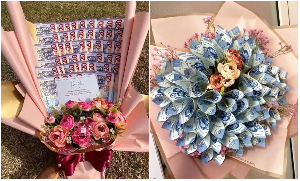
The elaborate cedi bouquet, folded, fanned, layered, and wrapped with ribbon, has become one of the defining visual languages of Ghanaian celebrity gifting culture.
At concerts, award after-parties, birthday bashes, wedding receptions, and graduation celebrations, event planners build them into packages as standard. Gift vendors have built entire businesses around them.
For birthday celebrants, receiving one on stage has become a marker of status.
Behind every bouquet is a quiet supply chain most people never think about.
It starts with the bank "plug," the contact who can source fresh, crisp, uncirculated notes in bulk.
Then comes the wrapper, who folds and arranges the notes into whatever design the client wants, roses, fans, towers, custom shapes.
Then the delivery person, who transports the finished product to the venue. And waiting at the other end is the social media blogger or videographer, ready for the moment the bouquet is presented.
Every single link in that chain is now affected.
The BoG stated plainly that the cedi was issued solely for use as legal tender and should not be transformed into decorations, jewellery, or artistic displays, specifically citing folding, piercing, and stapling as forms of tampering.
A single elaborate bouquet, depending on denomination, can cost between GH¢500 and GH¢5,000 to produce. That business has been banned overnight.
What Comes Next?
The directive does not propose an alternative. It draws a line and leaves the industry to figure out what stands on the other side of it.
Will mobile money displays replace physical bouquets? Will gift vouchers or luxury hampers become the new status symbol at celebrity events?
Or will the practice simply continue informally, with enforcement as the only real deterrent?
That last question matters most.
Enforcement?
Ghana has passed directives before that have struggled against deeply embedded cultural practices.
The plastic bag ban took years to meaningfully enforce. The styrofoam ban is still six months away from its implementation date, with enforcement infrastructure still being built.
But the BoG is not the EPA.
Its reach into the financial system is considerably more direct, and the reputational risk for entertainers and event planners caught publicly violating a BoG directive is considerably higher than being seen with a takeaway pack.
For Ghana's entertainment industry, the money bouquet era may end with a quiet, uncomfortable awareness that the next viral birthday video could be evidence of a crime.
GhanaWeb Explainer by Isaac Dadzie
ID/EB
Talkertainment: Enyo Trey shares dreams and aspirations as a rising artiste

Copyright © 1994 - 2026 GhanaWeb. All rights reserved.










