



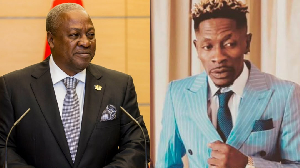
 Shatta Wale calls for clear laws to tackle defamation, harassment while protecting free speech
Dancehall musician Charles Nii Armah Mensah Jr, known in showbiz as Shatta Wale, has advocated for clear laws and regulations to tackle online defamation, harassment and abuse while protecting the right to free expression.
His call comes in response to President John Dramani Mahama’s recent concerns about the growing use of TikTok and other digital platforms for misinformation, insults and other forms of harmful content.
President Mahama, speaking at a town hall meeting with the Ghanaian community in New York on September 25, 2026, called for a national stakeholder discussion on how Ghana should regulate TikTok and other new media platforms.
He urged the Ghana Journalists Association (GJA) and the Media Foundation for West Africa (MFWA) to bring relevant stakeholders together to determine how the country should approach online content and whether the police should be involved in enforcing regulations.
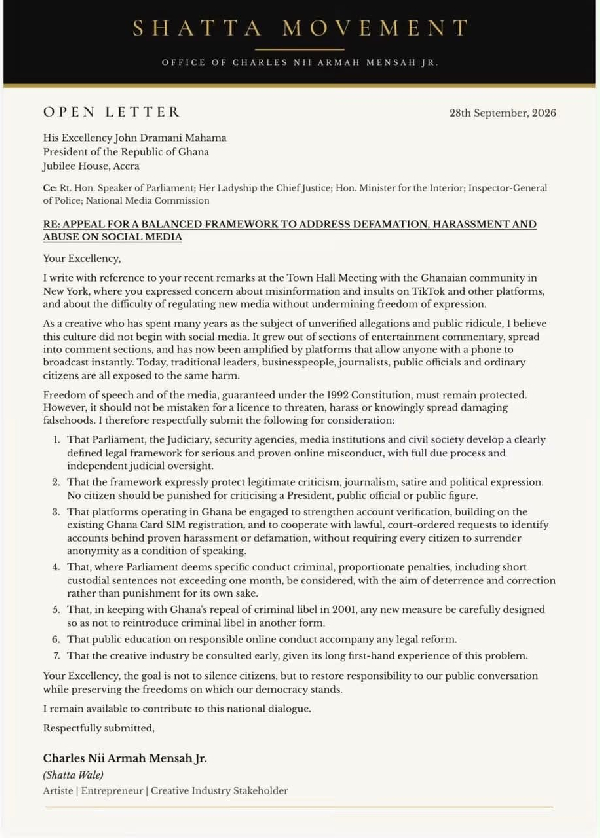
In response to these concerns, Shatta Wale, in an open letter to President Mahama dated September 28, 2026, said any attempt to address harmful online conduct must carefully balance accountability with the constitutional right to freedom of expression.
He said his position was informed partly by his own experience as a public figure who has been subjected to what he described as unverified allegations and public ridicule over the years.
According to Shatta Wale, the problem of harmful commentary did not begin with social media.
‘They make the money and give the artiste a piece of wood’ - Shatta Wale
He argued that it existed within sections of entertainment commentary before spreading to online comment sections and later being amplified by digital platforms that allow individuals to reach large audiences instantly.
He noted that the impact now extends beyond entertainers, with traditional leaders, businesspeople, journalists, public officials and ordinary citizens also exposed to online harassment and other forms of abuse.
Shatta Wale stressed that freedom of speech and freedom of the media, as guaranteed under Ghana’s 1992 Constitution, must remain protected.
However, he argued that those freedoms should not be interpreted as permission to threaten, harass people or knowingly publish false information that causes harm.
He therefore proposed that Parliament, the Judiciary, security agencies, media institutions and civil society organisations work together to develop a clearly defined legal framework for serious and proven online misconduct.
He said any such framework should include full due process and independent judicial oversight to prevent legitimate expression from being criminalised.
Shatta Wale also called for explicit protection for legitimate criticism, journalism, satire and political expression, stressing that citizens should not be punished simply for criticising the President, public officials or other public figures.
Another proposal concerns the identification of accounts involved in proven cases of online harassment or defamation.
He suggested that social media platforms operating in Ghana should be engaged to strengthen account verification, building on the existing Ghana Card and SIM registration system.
At the same time, he said such measures should not require every citizen to give up anonymity as a condition for participating in public discourse.
He proposed that platforms cooperate with lawful, court-ordered requests to identify individuals behind accounts where serious cases of harassment or defamation have been established.
On possible sanctions, Shatta Wale suggested that where Parliament determines that specific forms of online conduct should be criminalised, penalties should be proportionate.
He proposed that short custodial sentences of not more than one month could be considered in appropriate cases, arguing that the purpose should be deterrence and correction rather than punishment for its own sake.
He further urged caution in drafting any new legislation to ensure that Ghana does not effectively reintroduce criminal libel in another form, following the country’s repeal of criminal libel in 2001. Parliament has previously documented the repeal of criminal libel as part of Ghana’s efforts to protect media freedom.
Beyond legislation, Shatta Wale called for public education on responsible online conduct to accompany any reforms.
He also urged authorities to involve the creative industry early in the process, arguing that entertainers and other creative professionals have first-hand experience of the challenges posed by online abuse and defamatory content.
For Shatta Wale, the objective of any new framework should not be to silence citizens or restrict legitimate criticism.
Rather, he said Ghana should seek to promote greater responsibility in public discourse while maintaining the freedoms that underpin the country’s democratic system.
“Your Excellency, the goal is not to silence citizens, but to restore responsibility to our public conversation while preserving the freedoms on which our democracy stands,” he stated.
He concluded by expressing his readiness to contribute to the national conversation on how Ghana can address harmful online conduct while protecting freedom of expression.
AK/AM

Copyright © 1994 - 2026 GhanaWeb. All rights reserved.










