



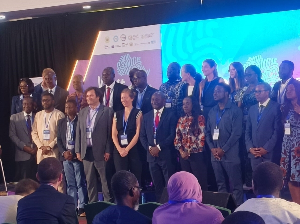
 West Africans at West Africa Bio-manufacturing Regulation and Market Access Conference
West African countries are leveraging regional frameworks to harmonise biomanufacturing regulations, experts said at the West Africa Bio-manufacturing Regulation and Market Access Conference in Accra.
The approach aims to strengthen local vaccine production, biologics manufacturing, and biotechnology innovation across the region.
Dr Delese Darko, Director-General of the African Medicines Agency, emphasised that West African nations do not start from scratch when building biomanufacturing regulations.
Instead, they adapt existing regional harmonisation models from medicines, agriculture, and biosafety to advanced biotechnology.
She said, "West Africa has already demonstrated success in harmonising regulatory frameworks for medicines and vaccines, and that the key now is to translate these successes into biomanufacturing, ensuring that vaccines or biologics produced in one country are trusted and accepted across the region without unnecessary delays.”
Dr Darko added that regional collaboration is essential for achieving Africa’s target of producing 60% of its vaccines locally by 2040. Currently, the continent imports over 95% of vaccines, posing serious health risks.
Regional Harmonisation: The Blueprint
Experts at the Forum outlined a regional-first, national-implementation strategy: through the use of Regional Bodies to Lead Framework Design.
According to them, the Economic Community of West African States (ECOWAS) sets policy, while the West African Health Organisation (WAHO) coordinates technical and regulatory work.
The West Africa Medicines Regulatory Harmonisation (WA-MRH) initiative, which created a shared system for drug and vaccine approvals across 15 countries, provides a transferable model for biomanufacturing.
They also noted the Development of Common Technical Standards, where Harmonisation extends to technical requirements such as Good Manufacturing Practice (GMP), clinical trials, pharmacovigilance, and biosafety protocols.
For biomanufacturing, this includes cell and gene therapy standards, bioprocess validation, and laboratory quality control.
The creation of Joint Assessment and Approval Systems. Instead of each country reviewing products independently, joint regulatory assessments allow a single scientific evaluation to be relied upon by multiple states, accelerating access to vaccines and biologics regionally.
The Promotion of Science and Innovation Policy Alignment – ECOWAS policy supports R&D, technology transfer, and intellectual property protection, critical for developing local biomanufacturing pipelines.
Integrate Biosafety, Traditional Medicine, and New Biotech into regulatory frameworks that are expanding to cover biologics, plant-based biotech, and genetically engineered products and moving toward Continental Alignment.
West Africa’s efforts, they indicated, must complement continental initiatives, including the African Medicines Regulatory Harmonisation (AMRH) and the African Medicines Agency (AMA), with the long-term goal of a unified African regulatory space.
According to Dr Sodzi Sodzi-Tettey, CEO of the National Vaccines Institute (NVI), despite progress, West Africa faces hurdles, including fragmented legal systems, language diversity, infrastructure gaps, and slow domestication of regional rules.
Also, the Director of Pharmaceutical Services at the Health Ministry, Saviour Yevutse, urged West African leaders to show strong political commitment toward producing 60% of Africa’s vaccines by 2040.
He warned that Africa’s reliance on imports for over 95% of vaccines poses serious health risks.
He highlighted the need for regional collaboration and harmonisation saying, “The region must move beyond communiqués and develop a concrete roadmap for procurement and market access.”
“A vaccine produced in Nigeria should be accepted in Ghana, and a biopharmaceutical from Senegal should reach Liberia without redundant bureaucratic delays.”
The forum called for stronger political commitment, capacity building, and harmonised procurement systems across member states to ensure West African biomanufacturing is globally competitive.

Copyright © 1994 - 2026 GhanaWeb. All rights reserved.










