



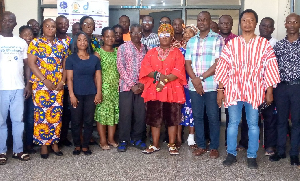
 Members of the Hope For Future Generation NGO in a group photo
Hope for Future Generations (HFFG), a non-government organisation, has organised a baseline information dissemination programme for stakeholders in the fight against Neglected Tropical Diseases (NTDs) in part of Eastern Region.
The stakeholders were the Regional and District Health Directorates, School Health Education Programme Coordinators, Traditional leaders, NTDs clients and selected volunteers.
NTDs are a diverse group of conditions caused by a variety of pathogens (including viruses, bacteria, parasites, fungi and toxins) and associated with devastating health, social and economic consequences.
Josephine Sackey, a Board Member of Hope for Future Generations, said: "A baseline survey provides the ground truth which helps in assessing the appropriate technology and services to introduce a change to solve the existing problem."
She said it will ensure that the implementation of the “Strengthening Community System to scale-up Community-led response interventions to end Neglected Tropical Diseases (Skin-NTDs)” project achieves desirable results.
The project is being implemented by HFFG in partnership with Rural Watch, with technical support from the Ghana Health Service, and funding by ANESVAD in seven districts.
She said the baseline information dissemination programme organised will enable researchers to make appropriate appeal for specific support to the stakeholders, and the stakeholders will provide them without much ado.
The NTDs endemic districts in the region are the Birim South, Birim North, Akyemansa, Denkyembour, Kwaebibirim, Lower Manya Krobo and Okere districts.
On her part, Carmen Narh, Project Coordinator, said she was optimistic about the success of the recommendations made by the stakeholders which were the need to scale up community NTDs education, remove financial barriers to care, strengthen Community-based services, and integrate traditional healers into referrals.
The rest were that the government must strengthen referral systems and provide adequate diagnostics and supplies.
She said the recommendations were realistic, practical, and possible to carry out in the implementation process of the endline survey.
Dr James A Avoka, Lower Manya Krobo Municipal Health Director, made a call on Community-based Groups, Non-Government Organisations and the Government to assist with "the appeal for support process for lymphatic filariasis and the likes to be captured into the National Health Insurance Scheme (NHIS)."
He said: "it is pathetic that, sometimes patients are stranded for not being able to pay for their hospital bills."

Copyright © 1994 - 2026 GhanaWeb. All rights reserved.










