



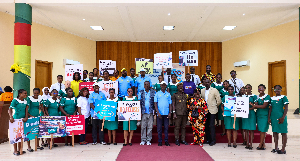
 UMaT celebrates Wprld Health Day
Correspondence from the Western Region
The University of Mines and Technology (UMaT) has intensified efforts to bridge academic knowledge with community impact, as environmental experts led a major outreach on plastic pollution during this year’s World Health Day celebration in Tarkwa.
Speaking as Guest Speaker, Associate Professor Eric Stemn, Head of the Environmental and Safety Engineering Department, stressed the need for universities to move beyond theory and actively engage communities in solving real-world problems.
“We need to find a way to interface the university with the community and see how we can impact society,” he said, expressing satisfaction with the outreach, which he described as “very impactful.”
The event was a collaborative effort between UMaT, the Nursing and Midwifery Training School in Tarkwa, and the Tarkwa-Nsuaem Municipal Assembly.
As part of the celebration, teams visited key locations including Tarkwa Station, Market Circle, and Aboso/Kumasi Station, where they engaged traders, drivers, and residents on the theme: “Plastic and Rubber: A Health and Environmental Crisis.”
Delivering brief educational sessions in multiple languages—Fante, Twi, Ewe, Dagbani, Hausa, and French—the team ensured inclusivity and wider understanding of the issue.
The outreach combined education with interaction, allowing community members to share their perspectives while learning about the dangers of plastic pollution.
Prof. Stemn highlighted the importance of participatory knowledge-building, noting that solutions must involve both experts and the public.
He also addressed common misconceptions, including the belief that banning plastics alone solves the problem.
According to him, burning plastics only transforms them into harmful gases, posing further health risks through air pollution.
On concerns about sachet water, he clarified that while it remains widely used, improper disposal of its packaging contributes significantly to environmental degradation.
Citing alarming statistics, Prof. Stemn revealed that Ghana now generates over 1.5 million tonnes of plastic waste annually, a sharp increase from 40,000 tonnes two decades ago.
Of this, only about 9–10 percent is recycled, leaving the majority to pollute the environment. He added that nearly half of plastic waste remains uncollected.
"In Tarkwa alone, each resident generates approximately 0.93 kilograms of waste daily, with plastics accounting for about 30 percent. This translates to nearly 200 tonnes of plastic waste generated every day in the municipality; he explained.
He warned that the situation is particularly dangerous in mining communities, where microplastics absorb toxic heavy metals such as mercury, arsenic, and lead from the environment. These contaminated particles can enter water bodies and the food chain, posing serious health risks.
To address the crisis, Prof. Stemn advocated simple, low-cost solutions, including reducing reliance on single-use plastics, reusing durable plastic materials, and adopting reusable shopping bags.
He emphasized that individual action is critical in tackling the growing menace, urging the public to make conscious choices in their daily lives.

Copyright © 1994 - 2026 GhanaWeb. All rights reserved.










