



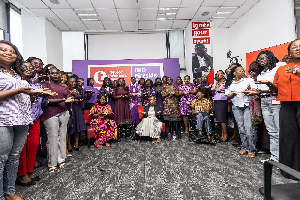
 The conversation explored practical strategies for women navigating careers
In celebration of International Women’s Month, Telecel Ghana hosted an inspiring and candid fireside conversation, featuring two of Ghana’s most accomplished industry leaders: software engineer and disability advocate, Farida Bedwei and tax and regulatory leader for PwC West Africa, Ayesha Bedwei Ibe, on the theme, Give to Gain: Powering our Progress.
Hosted at the telco’s headquarters in Accra, the two speakers shared reflections on their personal journeys and encouraged women to step forward, own their space, and embrace opportunities that can drive the next stage of their career growth.
For Farida, a trailblazer in Ghana’s technology ecosystem, progress for women in Science, Technology, Education, Arts and Mathematics (STEAM) will only accelerate when women become more visible and intentional about their ambitions.
“We need to be out there and show our skills; otherwise, no one will recognise us. Stop being shy and talk about your achievements. No one will come to your corner to look for you if they don’t know what you can do,” she said.
Ayesha concurred, explaining that visibility is an essential leadership skill in today’s professional world.
“I post on LinkedIn three times a week. Otherwise, how will anybody know about my work if I don’t share it? You must constantly put yourself out there, and it can be in the form of writing, networking or engaging consistently with people.”
Despite growing global conversations about women in technology, Farida said the industry still struggles with retaining women in technical careers.
“We talk about women in STEAM and coding, and we train them, but many do not pursue it as a career. We need continuity. There are opportunities everywhere, from AI to quantum technologies, but the question is: are women really interested in taking them?”
Ayesha spoke movingly about the defining moment that reshaped her life and career, the death of her late husband and having to raise their one-year-old child alone.
“If you make the decision that you want to reinvent yourself, that’s half the work done. It’s about being intentional and sometimes doing the work that no one wants to do. You must consciously put your hand up and say you are available,” Ayesha said.
Beyond personal leadership, the conversation also addressed the structural barriers that continue to shape technology and finance.
Farida warned that emerging technologies, particularly artificial intelligence, risk deepening inequality if women and persons with special needs are absent from the design process.
She urged organisations to ask critical questions when building digital platforms to minimise exclusion.
“Learning models train AI engines. If the diversity of the people training those systems is low, the results will be biased. Simple things like making apps and websites accessible to people living with disabilities can go a long way. When we design systems and programmes, we need to recognise that people have different needs,” Farida said.
The conversation also explored practical strategies for women navigating careers, from negotiating salaries to managing family expectations.
Ayesha encouraged young professionals to do more research and prepare rigorously for opportunities, as that would build their confidence and competence in negotiating their value and salaries better.
Ayesha also emphasised the importance of building personal confidence, financial independence and boundaries.
“Farida and I were raised to believe there is nothing we cannot do. When you grow up with that mindset, half the battle is already done,” she said.
“Additionally, building your financial independence as a woman is everything. Save, invest and manage your income wisely.”
For Farida, real progress will only come when women occupy the rooms where decisions are made.
“How many women sit on boards? How many lead agencies? We need women in strategic positions who will make an impact. Beyond believing in your abilities, position yourself more visibly and be ready to occupy higher positions.”
In her closing remarks, Telecel Ghana’s CEO, Ing. Patricia Obo-Nai, reflected on the power of the stories shared by the two speakers and how they embody the spirit of the global theme, Give to Gain.
“Here are two women who faced very different challenges, but despite that, they stepped up, invested in themselves and gave their talents to society. These are women who have baked the pie, and today we are taking slices from it. Thank you for sharing your stories and insights with us,” Ing. Obo-Nai said.
Beyond the Fireside Chat, Telecel Ghana is celebrating International Women’s Month with a focus on digital inclusion and leadership. Central to the activities is the rollout of She Codes, a virtual coding initiative designed to equip 1,000 young girls across Ghana with foundational digital skills in coding and digital skills, as part of efforts to expand opportunities for girls in STEAM.
The telco will climax the month with its annual Women 100 Connect, a networking and leadership platform which brings together women leaders, professionals and emerging talent for conversations on professional growth, influence and leadership.

Copyright © 1994 - 2026 GhanaWeb. All rights reserved.










