



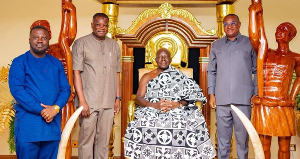
 The government has secured the support of Otumfuo Osei Tutu II as GAF starts Accra-Kumasi expressway
The Government of Ghana, through the Ghana Armed Forces, has begun clearing the right of way for the construction of the 198-kilometre Accra–Kumasi Expressway, a transformative flagship infrastructure project initiated under the NDC government led by President John Dramani Mahama.
The project, which spans the Ablekuma-Oda-Sewia corridor, is expected to significantly reduce travel time between the capital and the Ashanti Region while opening up new economic corridors.
As part of stakeholder engagement efforts, a high-powered government delegation paid a courtesy call on the Asantehene, Otumfuo Osei Tutu II, at the Manhyia Palace. The visit sought the blessings and support of the traditional authority, whose influence remains pivotal in land-related and development matters in the Ashanti Region.
The delegation was led by the Minister for Roads and Highways, Kwame Governs Agbodza, and included the Deputy Minister, Alhassan Suhuyini, alongside the Deputy Minister of Defence, Ernest Brogya Yaw Genfi, Ashanti Regional Minister, Frank Amoakohene, Chief Directors from both the Defence and Roads Ministries, the Chief of Defence Staff, and heads of key national and regional agencies.
Revealing in an address, the Deputy Defence Minister, Ernest Brogya Yaw Genfi, noted: “The right-of-way clearing exercise began in March 2025 and is projected to be completed within 20 weeks”.
Highlighting the broader significance of the initiative, Brogya Genfi described the project as “a major step in strengthening connectivity, boosting trade, and advancing national development, underscoring the government’s commitment to infrastructure-led growth."
Reacting to this, the Asantehene, Otumfuo Osei Tutu II, assured the delegation of his full support for the project and urged the team to remain focused on delivery despite public criticism.
The Accra–Kumasi corridor has long been a critical artery for trade and transportation, linking the southern parts of the country to the middle and northern belts, as well as facilitating cross-border commerce with neighboring countries.
Over the years, increasing traffic congestion, road deterioration, and safety concerns have highlighted the urgent need for a modern expressway to ease pressure on existing routes.
The new expressway is expected to significantly cut travel time, reduce vehicle operating costs, and improve overall road safety while opening up new areas for commercial and industrial development. Work is expected to be completed within three years, aiming for 2028–2029.

Copyright © 1994 - 2026 GhanaWeb. All rights reserved.










