



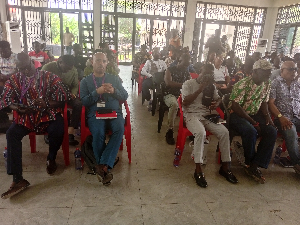
 The engagement comes in the wake of the 2023 controlled spillage of the Akosombo and Kpong dams
Correspondence from the Eastern Region
The Volta River Authority (VRA) has intensified efforts to strengthen flood preparedness and environmental protection in downstream communities with the organisation of its annual Emergency Preparedness Plan (EPP) and Environmental Management Plan (EMP) workshop in the Lower Manya Krobo Municipality.
The one-day stakeholder engagement, held on April 22, 2026, forms part of a long-standing strategy by the Authority to mitigate risks associated with potential emergencies at the Akosombo Dam and Kpong Dam. The initiative targets ten districts located downstream of the dams, where communities remain vulnerable to flooding during controlled spillages or extreme hydrological events.
Strengthening Awareness and Preparedness
Addressing participants, Engineer Philip Tetteh Padi, Lead Engineer for Integrated Water Resources Management at the VRA, underscored the importance of sustained stakeholder engagement since the EPP framework was introduced in 2010.
“We engage communities annually to ensure that lives, property, and livelihoods are protected in the unlikely event of an emergency. It is not an indication that disaster will occur, but preparedness is critical,” he explained.
The workshop focused on improving understanding of inundation maps, identifying flood-prone zones, and clarifying the roles and responsibilities of key actors during emergencies. Simplified training manuals and infographics were also distributed to enhance grassroots communication and public education.
Lessons from Past Spillages
The engagement comes in the wake of the 2023 controlled spillage of the Akosombo and Kpong dams, an operation necessitated by rising water levels in the Volta Lake due to heavy inflows and climate variability. According to VRA data, approximately 8 million acre-feet of water were released to prevent overtopping, a scenario that could have led to catastrophic dam failure.
Historical records indicate that the 1968 spillage event was nearly five times larger than the 2023 discharge, highlighting the increasing unpredictability of hydrological patterns due to climate change.
Despite the scale of the 2023 exercise, authorities recorded no loss of life—an outcome widely attributed to continuous stakeholder sensitisation and early warning systems.
Persistent Gaps in Community Engagement
However, findings from recent assessments reveal a critical gap: information shared at stakeholder workshops is not consistently reaching local communities.
Engineer Padi noted that while institutional stakeholders participate actively, many fail to cascade the information to residents. “The challenge is not just awareness at the top level, but ensuring that the message reaches the last mile,” he said, urging participants to utilise platforms such as churches, mosques, and community gatherings for education.
NADMO Calls for Intensified Outreach
The National Disaster Management Organisation (NADMO), represented by Deputy Chief Disaster Control Officer Kwaku Saviour Woanya, acknowledged progress but admitted that public response remains mixed.
“We estimate that awareness levels are about 50 per cent. Many residents still doubt the potential severity of flooding, which affects their preparedness,” he stated.
NADMO outlined ongoing interventions, including school outreach programmes, community education campaigns, and media engagements. The agency also announced plans to introduce simulation exercises and expand disaster volunteer groups and school-based clubs to improve practical understanding of evacuation procedures.
Addressing Environmental and Development Risks
A key theme of the workshop was the increasing encroachment on waterways and floodplains, which experts warn could exacerbate disaster impacts. Participants were urged to enforce land-use regulations and discourage construction in high-risk zones identified through updated hazard mapping.
The EMP discussions also highlighted the need for sustainable environmental practices to complement disaster risk reduction efforts.
Looking Ahead
As part of its forward strategy, the VRA and its partners plan to:
Expand community-level engagements beyond institutional stakeholders
Develop and publicise safe evacuation routes and designated safe havens
Conduct simulation drills to improve emergency response readiness
Strengthen collaboration with local authorities and security agencies
The annual EPP/EMP workshops, which have been held consistently since 2011 except during the COVID-19 pandemic, remain a cornerstone of Ghana’s dam safety and disaster risk management framework.
With climate variability increasing the likelihood of extreme weather events, authorities say sustained education, community involvement, and proactive planning will be essential to safeguarding vulnerable populations along the Volta Basin.

Copyright © 1994 - 2026 GhanaWeb. All rights reserved.










