



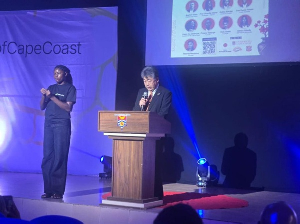
 The Chargé d'Affaires at the embassy, Naoki Mitori speaking at the event
Japan has opened new academic pathways for Ghanaian students through expanded scholarship schemes, university programmes and exchange opportunities aimed at strengthening educational cooperation between the two countries.
The Japanese Ambassador to Ghana, Hiroshi Yoshimoto, announced this during a presentation on the first day of a TEDx event at the University of Cape Coast (UCC), where he outlined various opportunities available to students seeking higher education in Japan.
The presentation, themed around studying abroad and international education in Japan, introduced participants to scholarship opportunities, university programmes, student exchange initiatives and visa procedures.
Yoshimoto said Japan’s education system offered a conducive environment for academic excellence, innovation and global exposure, making it an attractive destination for international students.
He explained that Ghanaian students could access a wide range of undergraduate, postgraduate and research opportunities through Japanese universities and government-supported scholarship programmes.
The ambassador highlighted the Japanese Government’s Ministry of Education, Culture, Sports, Science and Technology (MEXT) scholarship programme, which provides financial support to qualified international students.
He noted that Japan was increasingly expanding English-taught degree programmes to make its institutions more accessible to students from non-Japanese speaking countries.
According to him, students who choose Japan would benefit not only from quality education but also from exposure to advanced technology, research facilities and diverse cultural experiences.
Yoshimoto encouraged students to begin preparing early by researching available programmes, meeting application requirements and exploring scholarship opportunities.
He also advised prospective applicants to develop strong academic records and cultivate international perspectives that would enable them to thrive in a globalised world.
Shared Ghanaian-Japanese Values
The Chargé d’Affaires, Naoki Mitori, highlighted the Japanese concept of kintsugi, the traditional art of repairing broken pottery with lacquer mixed with gold powder.
He explained that rather than concealing cracks, the practice embraces them as part of an object’s history, making it even more valuable and unique.
Drawing a parallel with the Ghanaian expression “Akyea nanso emmuie”—meaning “it is bent, but it has not broken”—he noted that both cultures share a common appreciation for resilience and recovery.
According to him, the similarity demonstrates that despite geographical and cultural differences, Ghanaian and Japanese societies value perseverance, strength and the ability to transform challenges into opportunities for growth and renewal.
Participants were taken through practical information on admissions processes, student life, accommodation and support services available to international students.
The event formed part of efforts to broaden awareness of international education opportunities and deepen educational engagement between Ghana and Japan.

Copyright © 1994 - 2026 GhanaWeb. All rights reserved.










