



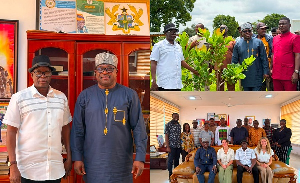
 The engagement forms part of an ongoing national consultation with MMDAs
The Office of the Minister of State for Climate Change and Sustainability has intensified Ghana’s drive to decentralize climate governance through a series of regional consultations across the country. As part of this nationwide exercise, the Office commenced its Upper East Regional engagements on Monday, 27 July 2026, with a high-level courtesy call on the Upper East Regional Minister, Akamugri Donatus Atanga, ahead of the Upper East Regional Stakeholder Consultation on Climate Change and Sustainability.
The engagement forms part of an ongoing national consultation with Metropolitan, Municipal and District Assemblies (MMDAs) and key stakeholders on the proposed establishment of a National Climate Change and Sustainability Hub and Climate Change and Sustainability Units (CCSUs) within local government structures to strengthen decentralized climate governance across Ghana.
Leading the delegation, the Minister of State for Climate Change and Sustainability, Seidu Issifu, explained that the forthcoming regional consultation seeks to gather inputs from MMDAs and key stakeholders on the two proposed institutional reforms.
The National Climate Change and Sustainability Hub is envisioned as Ghana’s center for climate research, innovation, capacity building, partnerships, and climate finance coordination, while the Climate Change and Sustainability Units will embed climate governance within all Metropolitan, Municipal and District Assemblies.
According to the Minister, the consultations will provide the evidence and stakeholder consensus required to support a Cabinet Memorandum that will institutionalize these structures nationwide.
“Sustainability is fundamentally about ensuring that today’s development does not compromise the well-being of future generations. The decisions we make today—whether through bush burning, pollution of our water bodies, unsustainable farming practices, or environmental degradation—will determine the quality of life for generations to come,” Seidu Issifu stated.
He further noted that the Office of the Minister is working to build stronger partnerships with Regional Coordinating Councils and MMDAs to improve access to climate finance and accelerate locally led climate adaptation and sustainable development initiatives.
The Minister also highlighted Ghana’s collaboration with the Global Centre for Climate Mobility (GCCM), explaining that climate change is increasingly driving human mobility, disrupting livelihoods, and creating emerging development and security concerns.
He stressed the need to strengthen adaptation planning and prepare communities for climate-induced displacement while supporting both origin and host communities.
Welcoming the delegation, Akamugri Donatus Atanga reaffirmed that climate change remains one of the Upper East Region’s most pressing development challenges. He pointed to declining agricultural productivity, illegal mining, environmental degradation, and increasing production costs for farmers as some of the region’s most urgent concerns.
“The Upper East Region has always been one of Ghana’s food baskets. While mining may attract many young people, we do not eat minerals. Agriculture remains the backbone of our economy, and protecting it through climate adaptation must remain a national priority,” the Regional Minister remarked.
Akamugri Donatus Atanga further informed the delegation that the Upper East Regional Coordinating Council has developed a Regional Environmental Framework that incorporates climate change considerations and requested closer collaboration with the Office of the Minister to strengthen its implementation through national technical expertise.
During the engagement, the Environmental Protection Agency (EPA) provided a technical briefing on the region’s climate outlook, noting that rising temperatures, prolonged heatwaves, and declining soil moisture are already affecting agricultural productivity across the Upper East Region.
The Agency explained that although the quality of fertilizers and agrochemicals remains unchanged, changing climatic conditions have significantly reduced their effectiveness, compelling farmers to apply larger quantities at higher cost while achieving lower yields. The briefing also highlighted increasing environmental degradation associated with illegal mining activities.
As part of the engagement, Seidu Issifu, Akamugri Donatus Atanga, and their delegation visited the Ghana Productive Safety Net Project II (GPSNP2) plantation site at Nyogbari in the Nabdam District.
The delegation inspected the 10-hectare degraded communal land rehabilitation project, which integrates cashew plantation development with a 20,000-seedling nursery. The field visit provided valuable insight into practical climate adaptation measures that are restoring degraded ecosystems, strengthening climate resilience, improving food security, and creating sustainable livelihoods.
The Ministers interacted with project beneficiaries and reaffirmed the Government’s commitment to scaling up nature-based solutions as part of Ghana’s climate resilience agenda.
The Upper East Regional Coordinating Council used the engagement to request increased support for climate adaptation, climate-smart agriculture, district-level climate finance, ecosystem restoration, and stronger collaboration between national and regional institutions.
The Regional Minister assured the delegation that all District Chief Executives, Coordinating Directors, and Planning Officers would actively participate in the forthcoming Regional Stakeholder Consultation, reaffirming the Region’s commitment to implementing its outcomes.
The engagement underscored the Government’s commitment to ensuring that the forthcoming Regional Stakeholder Consultation reflects the realities and priorities of local communities.
By advancing the proposed National Climate Change and Sustainability Hub, institutionalizing Climate Change and Sustainability Units across MMDAs, strengthening partnerships with regional authorities, and promoting practical, community-driven adaptation initiatives, Ghana continues to build a decentralized and resilient climate governance system capable of responding effectively to the country’s evolving climate challenges.

Copyright © 1994 - 2026 GhanaWeb. All rights reserved.










