

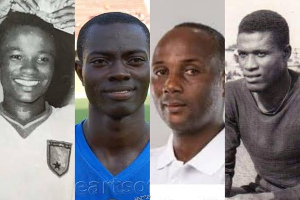
 Ali Jarrah, Baba Yara, Robert Mensah: Ghanaian footballers whose careers were cut short by tragedy
Football can make heroes out of ordinary men, turning their talent into a source of joy and pride for thousands of fans. But sometimes, just when the future looks brightest, tragedy strikes, leaving dreams shattered, careers cut short and families struggling to come to terms with a loss that no amount of applause or trophies can heal. Ghanaian football has witnessed such heartbreaking stories, with some of its most gifted talents forced to watch their dreams slip away through devastating injuries, while others never lived long enough to fulfil their potential. From career-ending injuries to fatal accidents and premature deaths, here are some Ghanaian sportsmen whose circumstances quickly changed even before they made their mark. Ali Jarrah Ali Jarrah was one of Ghana’s promising goalkeepers in the early 1990s, winning the FIFA U-17 World Cup with the Black Starlets in 1991 before helping Ghana finish second at the 1993 FIFA U-17 World Championship. His performances reportedly attracted interest from European clubs, including Liverpool and FC Köln. However, his career took a devastating turn in 1993 after he suffered an injury following a Hearts of Oak match against Asante Kotoko. The injury eventually left him paralysed, ending his playing career. Jarrah later transitioned into coaching and goalkeeper development. Baba Yara Known as the ‘King of Wingers’, Baba Yara was among Ghana’s most celebrated footballers in the 1950s and early 1960s. He represented the Black Stars and was part of the Ghana team that won the 1963 Africa Cup of Nations. His playing career ended abruptly on March 24, 1963, when he sustained severe spinal injuries in a road accident while travelling with his club, Real Republicans, after a match in the Volta Region. The accident left him paralysed. Despite receiving treatment in Ghana and the United Kingdom, he never returned to competitive football. He died on May 5, 1969, aged 32. Robert Mensah Robert Mensah remains one of Ghana’s most recognisable goalkeepers, remembered for his performances for Asante Kotoko and the national team. He helped Kotoko win the African Cup of Champions Clubs in 1970 and represented Ghana at the 1968 Africa Cup of Nations, where the Black Stars finished as runners-up. However, his life ended violently in November 1971 after he was stabbed following an altercation at a drinking establishment in Tema. He died at the age of 32. Unlike Jarrah and Yara, whose playing careers were curtailed by injuries, Mensah’s story ended with his death at a time when he remained an established figure in Ghanaian football. Meet Akwasi Alhassan: The Ghanaian goalkeeper who has been in prison for 37 years Ibrahim Dossey Ibrahim Dossey was a member of Ghana’s historic men’s football team that won bronze at the 1992 Olympic Games in Barcelona. The goalkeeper went on to play professional football in Romania, featuring for clubs including FC Brașov and Rapid București. His life took a tragic turn in September 2008 when he was involved in a serious road accident in Romania. He fell into a coma and died on December 9, 2008, aged 36, without recovering. His death brought an end to the life of a goalkeeper who had been part of one of Ghanaian football’s historic achievements. Uriah Asante Uriah Asante was one of Hearts of Oak’s exciting midfielders during his time with the club, where his technical ability and performances earned him recognition among supporters. After making an impression in Ghana, he moved to Tunisia to continue his career with Étoile du Sahel. He also played for EGS Gafsa. However, Asante died on June 13, 2016, after suffering cardiac arrest at the Korle Bu Teaching Hospital. He was only 24. His death shocked Ghanaian football, cutting short the life of a young player whose career still had room to develop. FKA/BAI THE LOWDOWN: GES PRO Speaks on SHS Placement Crisis and Teachers’ Strike
Read more

Other AFCON News
- 64 Battalion vs Kotoko’s 1983 Side: Which team left a bigger mark on Ghana football?
- Vinícius Jr sent off for hair in Real Madrid's win over Villareal
- Messi scores twice in first game since international retirement
- AFCON 2015, World Cup 2010: Five times the Black Stars broke Ghanaian hearts
- Patrice Motsepe confirms current term will be his last as CAF president
- World Cup Visa Scandal: 10 key things from Sports Ministry’s press conference
- 2026/27 Ghana Premier League: Week 6 Match Preview – Hearts of Oak vs Port City FC











