


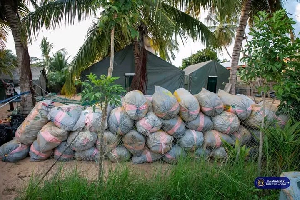
 The latest interception is expected to trigger further investigations by NACOC
The Ghana Navy, in collaboration with the Narcotics Control Commission (NACOC) and National Security, has intercepted two wooden boats carrying 117 sacks of substances suspected to be Indian hemp at the Ada Estuary.
The intelligence-led operation was conducted on Thursday, 5 November following surveillance and information gathered by the security agencies.
The consignment, estimated to weigh approximately 4.7 tonnes, comprised dried leaves packaged in more than 80 parcels per sack, with an estimated street value exceeding US$1 million.
According to the Ghana Navy, the suspects abandoned the two boats and their cargo after spotting the pursuing naval personnel and fled the scene.
Preliminary intelligence suggests the consignment was being transported out of the country.
No arrests have been made in connection with the operation so far.
The seized substances have since been handed over to NACOC for forensic examination and further investigations.
Speaking to the media, the Director of Naval Operations at Naval Headquarters, Naval Captain Festus Osei Brobbey, said the Navy had deployed its riverine detachment to strengthen security along the Volta Lake and surrounding communities.
He said the deployment was aimed at preventing illicit activities and enhancing surveillance across the waterway.
Naval Captain Brobbey underscored the importance of sustained patrols and intelligence gathering in tackling criminal activities, while commending community members for supporting security agencies with timely information.
The District Chief Executive for Ada East and Chairman of the District Security Committee (DISEC), Kenneth Kofi Kabu Kanor, also commended the Navy and its partner agencies for the interception.
He cautioned residents against allowing the Volta Lake to be used as a transit route for illicit drugs and urged them to report suspicious activities to the appropriate security agencies.
The latest seizure adds to a series of drug interceptions along the Ada and Volta Lake corridor, raising concerns about the use of Ghana’s waterways for illicit drug transportation.
On 27 March 2026, the Navy’s Special Boat Squadron intercepted a canoe off Goi Beach, south of Sege near Ada, and recovered 37 sacks containing approximately 2,590 parcels of suspected cannabis. No arrests were made.
On 17 September 2026, Marine Police at Ada intercepted another canoe at Tuanikopey Island on the River Volta. The vessel was carrying 29 sacks containing 2,213 slabs of suspected Indian hemp. The occupants reportedly fled.
The Volta Region has also recorded significant seizures involving cannabis cultivation and processing.
On 31 May 2026, NACOC seized 2,372 kilogrammes of suspected cannabis, valued at more than GH¢1.18 million, from a farmhouse and warehouse at Gbi-Wegbe near Hohoe.
Earlier, on 22 June 2026, the Commission dismantled what it described as a cannabis production hub at Koleonu, Wegbe and Akplamafu, arresting three suspects and recovering hashish oil.
NACOC has previously identified the Volta Region as one of Ghana’s major cannabis cultivation areas.
Under the Narcotics Control Commission Act, 2020 (Act 1019), cannabis remains prohibited for recreational use in Ghana.
Although the law provides for the licensing of cannabis cultivation for industrial and medicinal purposes under strict conditions, including a THC limit of 0.3 per cent, such cultivation is subject to regulatory approval and licensing requirements.
The latest interception is expected to trigger further investigations by NACOC and the other security agencies to establish the source and intended destination of the consignment and identify those behind the operation.
The authorities are also expected to pursue the suspects who abandoned the boats and escaped during the naval operation.

Copyright © 1994 - 2026 GhanaWeb. All rights reserved.










